

im getting married! what do i arrange first?
i’m getting married. what do i arrange first?
Congratulations. Seriously. Now put the phone down for five minutes and let the news sink in before you open a single spreadsheet or wedding planning app.
Done? Good. Because the next thing most people do is Google everything at once and end up overwhelmed before they’ve even told their parents. This article is not that. It’s a practical, honest checklist of what actually needs to happen first, in roughly the right order, so you can move forward without losing your mind.
the one thing that drives every other decision
Your venue determines almost everything else. The date, the guest list size, the catering, the setup, the flow of the day. This is not an exaggeration. Experienced wedding planners say it every time, and couples who didn’t listen say the same thing in hindsight.
Before you book a florist, before you taste cake, before you buy a dress or a suit, know where you’re getting married. And ideally, know it soon. Good venues book out a year or more in advance, sometimes two.
So the real answer to “what do I arrange first” is: pick your venue. Everything else is a consequence of that decision.
but first, the conversation you actually need to have
Before any venue visit, sit down with your partner and talk through a few things. Not the colour of the napkins. The big ones.
- Roughly how many people are we inviting?
- What kind of atmosphere do we want? Formal dinner, relaxed gathering, something in between?
- Do we want a ceremony and reception in the same place, or are we fine splitting them?
- What is our actual budget, not our dream budget?
- Are there any non-negotiables for either of us?
These questions sound obvious. Most couples skip them and end up in a venue that works for one of them and not the other. Twenty minutes of honest conversation now saves three months of confusion later.
what to look for in a wedding venue
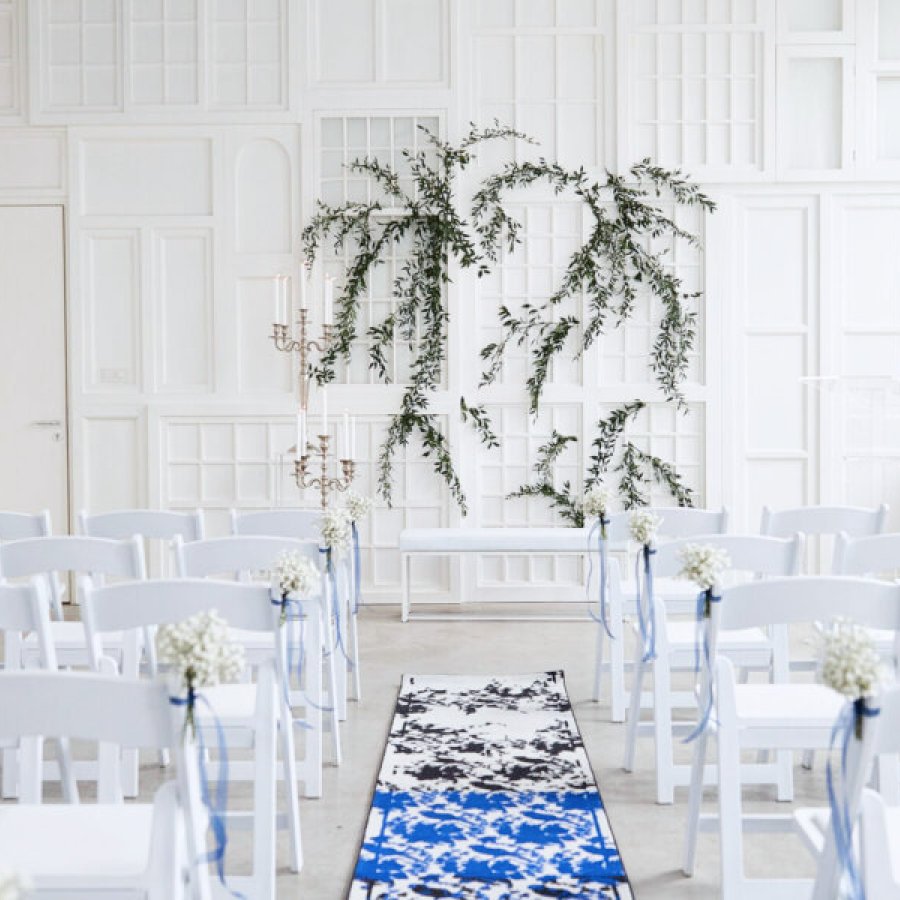
A wedding venue is not just a room. It’s the backdrop for photographs you’ll look at for decades, the space where your guests spend most of their time, and the frame around the whole day. These are the things that matter when you visit.
Capacity. Not just the number on the website. Ask how many people fit comfortably seated for dinner. Ask how it feels with 30 people in it on a quiet Tuesday. Ask whether the space looks empty below a certain number of guests. A room that holds 150 standing can feel cold and vast with 40 people sitting down to eat.
Layout and flow. Can people move easily between spaces? Is there room for a drinks reception while the dinner room is being set? Is the entrance practical? Where do people go when they need air?
Light. Natural light matters more than most people realise, for photos and for atmosphere. Visit during the time of day your event will actually run.
Sound. Is there a system already in place? Are there restrictions on music after a certain hour? Can the space handle a live band?
Kitchen and catering. Some venues have their own kitchen and team. Others require you to bring in external caterers. Both can work, but know which one you’re dealing with.
Flexibility. Can the space be configured in different ways? Does the team have experience adapting to last-minute changes?
@droog as a wedding venue in amsterdam
We don’t often lead with the word wedding. But the question comes up often enough that it’s worth being direct: yes, @droog hosts weddings, and yes, it suits them well.
The building dates from 1641. It housed the Drapers’ Guild. The rooms have been inhabited by designers, artists, and makers for decades, and that history shows in the materials, the furniture, and the way the light falls. It is not a neutral box. It is a place with character, which is exactly what some couples are looking for.
The white space is upstairs. Large windows look out onto the old Amsterdam houses and down into the garden. It holds up to 70 in theatre setting, or 50 seated with tables, depending on setup. It works for a ceremony, for a dinner, or for both in sequence.
The library is also upstairs. Ten people around a long table, yellow chairs, wallpaper based on a painting in the Rijksmuseum. It was designed as a meeting room. It works better as a private dinner table for the people who matter most.
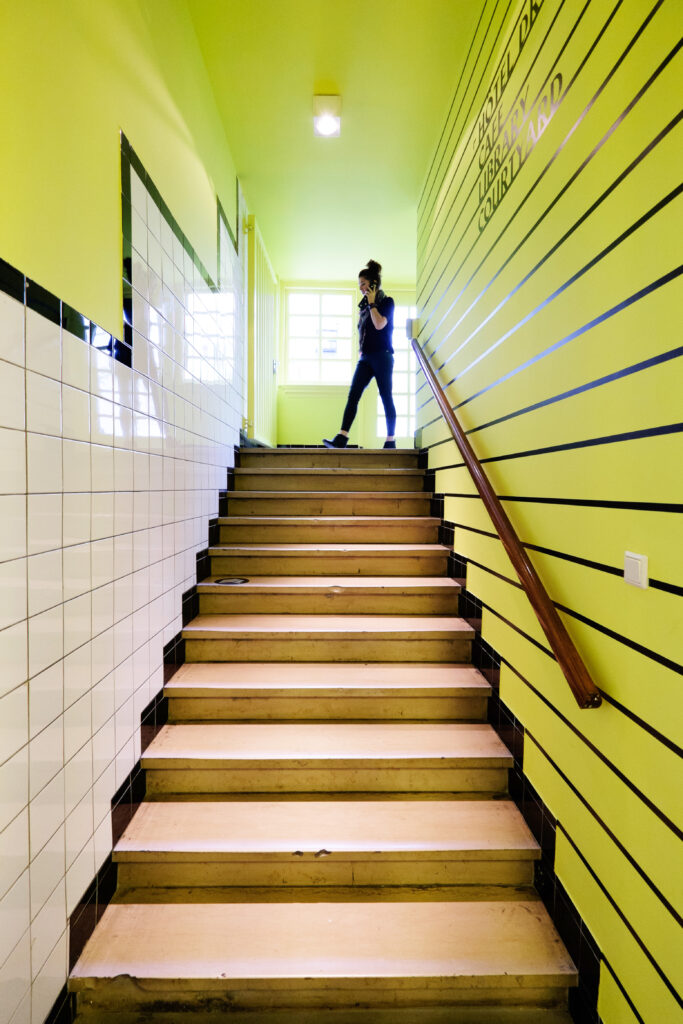
The cafe is at the top of the yellow hallway staircase. Blue butterfly lamp, curved white tiled bar, a fireplace, views over the Groenburgwal canal. It holds 70 seated or 180 standing. Our most designed space, and arguably our most beautiful.
The grand space is on the ground floor, with a giant sliding door connecting it to the garden and to the red space. Up to 90 seated, 160 standing. The stage is there if you need it.
Rooms don’t have to be used one at a time. A ceremony in the white space, drinks in the garden, dinner in the cafe, dancing in the grand space. That’s a full day, entirely within the building.
the first twelve steps, in order
Here is a realistic sequence for the first few months after your engagement. Not a rigid timeline, but a logic you can follow.
1. Set a rough budget. You don’t need exact numbers yet, but you need a ceiling. Venue, catering, and photography typically take up the largest share. Know what you’re working with before you fall in love with anything.
2. Decide on a rough guest count. The difference between 40 guests and 120 guests is enormous in terms of which venues are even possible. You don’t need the final list yet. You need a realistic bracket.
3. Think about timing. Do you want to get married this year? Next year? In spring or summer? Saturdays in June book first. If flexibility on day or month saves you money or opens up options, that’s worth knowing early.
4. Research and shortlist venues. Three to five venues is enough for a first round. Read the details. Look at photographs. Notice what the venue is like on an ordinary day, not just in the styled shoot they put on their website.
5. Visit your shortlist. In person. Ask the questions above. Walk through the space. Talk to the person who would actually be your contact on the day, not just the sales team.
6. Book the venue. When you find the right one, commit. This unlocks everything else.
7. Set the date. Coordinate with any immediate family who absolutely need to be there. Then set it and move forward.
8. Book your photographer. Good photographers are booked out as far as venues. This is your second most time-sensitive booking.
9. Decide on catering. If your venue includes catering, organise a tasting. If you’re bringing someone in, start conversations now.
10. Send save-the-dates. Six to twelve months in advance for a larger wedding. Eight to ten weeks for a small one. This can be a simple email or a card. It doesn’t have to be elaborate.
11. Think about your legal requirements. In the Netherlands, you need to register your intent to marry with the municipality (gemeente) at least two weeks before the wedding, but arrangements often need to start earlier. If either partner is a non-Dutch national, check the requirements early.
12. Then, and only then, the rest. Flowers, invitations, hair and makeup, rings, music, the cake. These all matter. They just don’t need to happen in week one.
the mistakes people make early
Booking vendors before the venue. If the venue has its own caterer, your external caterer booking is useless. If the venue has a fixed date in mind that doesn’t match the availability you assumed, your florist’s calendar means nothing. Venue first, always.
Telling too many people too early and then incorporating their preferences. Two people are getting married. Two people’s opinions are the ones that count in every decision. Extended family and friends have feelings about venues and dates and menus. Those feelings are lovely and entirely beside the point.
Underestimating what things cost. The gap between a couple’s initial budget estimate and their actual spend is, statistically, very large. Caterers who see the word wedding on an enquiry form sometimes adjust their pricing accordingly. Ask for itemised quotes. Compare them. Ask what happens if guest numbers change.
Trying to do everything at once. Planning a wedding is a project with a long timeline. Trying to complete it in the first two months leads to decision fatigue and regret. The things that need to happen in month one are the big structural decisions. Everything else has time.
frequently asked questions
how far in advance should we book our venue?
For a Saturday in a popular city in peak season, 12 to 18 months is not unusual. For a midweek date or a smaller gathering, six to nine months is often enough. The safest approach: start looking as soon as you’ve settled on a rough guest count and a general time of year.
can we have both the ceremony and the reception at the same venue?
Yes, and it makes the day significantly smoother for guests. Not all venues can accommodate this depending on layout and licensing, so ask explicitly when you visit.
what’s the difference between a wedding planner and a venue coordinator?
A venue coordinator works for the venue and manages what happens within the building on your behalf. A wedding planner works for you and manages everything, including external vendors, logistics, and the day-of schedule. For a complex day with many moving parts, a planner is worth the investment. For a more contained event at a venue with good support, a coordinator is often enough.
do we need a rehearsal dinner?
Not necessarily. It’s common in some cultural traditions, less so in others. If you have a wedding party with a ceremony that involves coordinated movement, a brief run-through the day before helps. A full dinner attached to it is optional.
how many guests is considered a small wedding?
Roughly under 50. Under 30 is considered intimate. Under 15 is micro. The category matters less than knowing which one you’re planning, because venues, catering, and logistics scale very differently across those ranges.
is it possible to have a wedding at @droog?
Yes. The building has multiple spaces that can be combined or used separately, depending on the size and shape of your day. The team has experience with events of all kinds and can advise on what configuration works for your guest count and format. The best starting point is a conversation.
what’s the most overlooked cost in wedding planning?
Service charges and taxes on top of quoted prices. Corkage fees if you bring your own wine. Overtime charges if the event runs long. Transport between venues if you’re splitting your day across locations. These are not huge individually, but they add up quickly. Ask about them upfront.
do venues get booked faster on certain days or months?
Yes. Saturdays in May, June, and September are the most sought-after in the Netherlands. Friday evenings and Sundays are increasingly popular and often more available. January and February are quietest, which can mean better pricing and more flexibility.
one last thing
The wedding industry is very good at making you feel like you’re behind. You’re not behind. You’re just getting started. The decisions that matter most in the first month are the ones that create structure: a rough guest number, a realistic budget, and a venue that feels right. Everything else builds from there.
If you’re considering Amsterdam, and you want a space that has character without performing it, we’re happy to show you around and talk through what your day might look like here.