

how to register marriage in amsterdam as a foreigner at gemeente amsterdam
how to register your marriage in amsterdam as a foreigner at gemeente amsterdam
Amsterdam is one of the most popular cities in the world to get married. The canals, the architecture, the light. But before any of that happens, there is paperwork. And if you are a foreigner, the paperwork is worth understanding well before you book anything else.
This guide walks you through the official process of registering your marriage at Gemeente Amsterdam, the municipality that handles all civil formalities for weddings in the city. We cover what you need, when you need it, and what foreigners specifically should watch out for.
what is gemeente amsterdam and why does it matter
Gemeente Amsterdam is the city’s municipal authority. In the Netherlands, a legal marriage must be registered through the municipality where the ceremony takes place. That means if you want to marry in Amsterdam, Gemeente Amsterdam is your starting point, not a venue, not a wedding planner.
The municipality handles the civil registration, issues a marriage certificate, and assigns a registrar (in Dutch: ambtenaar van de burgerlijke stand) to officiate your ceremony. You can marry in Dutch or in English, depending on the registrar assigned to you, so it is worth confirming this in advance.
Since 1998, the Netherlands has also legally recognised same-sex marriage. All couples, regardless of gender, follow the same registration process.
step one: check your eligibility
Before anything else, confirm that both partners are legally allowed to marry in the Netherlands. The rules are clear:
- Both partners must be at least 18 years old.
- Neither partner may already be married or in a registered partnership that has not been legally dissolved.
- Partners may not be closely related by blood or adoption (first-degree relatives).
- At least one partner must have a valid connection to Amsterdam, either through residency or by holding the ceremony there.
You do not have to be a Dutch citizen or resident to marry in Amsterdam. Foreigners are welcome to marry here. However, Gemeente Amsterdam will require proof that your home country does not legally prohibit the marriage. This is where the process gets specific.
step two: gather your documents
This is where most foreign couples lose time. Start collecting documents at least three to six months before your planned date. Some certificates take weeks to apostille, translate and authenticate.
Here is what Gemeente Amsterdam typically requires from foreign nationals:
- Valid passport or identity document for both partners.
- Birth certificate for both partners, issued by the country of birth. Must be recent (usually no older than six months), officially translated into Dutch or English, and apostilled or legalised depending on your country.
- Proof of civil status: a certificate of no impediment (also called a certificate of marital status or a declaration of celibacy). This document confirms you are not currently married. It must come from your home country’s civil authority and must be apostilled and translated.
- Proof of residence: if you are registered in the Netherlands (BRP), a BRP extract from Gemeente Amsterdam. If you live abroad, proof of your current foreign address.
- Divorce decree or death certificate if either partner was previously married. These must also be apostilled and translated.
Documents not in Dutch, English, French or German must be translated by a certified translator (beëdigd vertaler). Gemeente Amsterdam will not accept informal translations.
If your country does not issue certain documents (some countries do not issue a formal certificate of no impediment), the Dutch consulate or a notary in your home country may be able to provide an alternative declaration. Contact Gemeente Amsterdam early to discuss your specific nationality situation.
apostille, legalisation and what the difference is
This confuses a lot of people. Here is the short version.
An apostille is a stamp or certificate attached to an official document by your country’s designated authority, confirming the document is genuine. It is used between countries that have signed the Hague Convention of 1961. Most countries use apostilles. You get one from a national authority in your home country, often the Ministry of Justice or a regional court.
Legalisation is an older, more complex process required when your country has not signed the Hague Convention. It involves your home country’s foreign ministry stamping the document, then the Dutch embassy in your country adding their stamp. Some countries require both steps plus additional verification.
Check the list of Hague Convention member states before assuming which process applies to you. A few countries, including some in Africa and the Middle East, are not members and require full legalisation chains.
step three: submit your notice of intent to marry
In the Netherlands, you must formally notify the municipality of your intention to marry before the ceremony can take place. This is called the aangifte huwelijk or marriage notification.
You submit this at Gemeente Amsterdam’s civil affairs desk (Burgerzaken). An appointment is required. You can book online through the Gemeente Amsterdam website at gemeente.amsterdam.nl.
Both partners do not always need to appear in person for this initial step. One partner can sometimes submit on behalf of both, depending on the documents involved. Confirm this when you book your appointment.
The notification opens a window of one year during which the marriage must take place. If you do not marry within that year, you must resubmit the notification.
Gemeente Amsterdam processes the notification and checks all documents. If everything is in order, they will issue confirmation that you are free to marry in Amsterdam. This confirmation is sometimes called a marriage licence or huwelijkstoestemming.
step four: choose your ceremony type
Amsterdam offers three main formats for the civil ceremony:
- A free ceremony at the registry office (Buitenveldert or Stadsloket Centrum): quick, functional, takes around fifteen minutes. This option is free of charge.
- A ceremony at the registry office with more time: a longer appointment with a few personal elements, at a modest fee.
- A ceremony at a location of your choice: the registrar comes to an approved external venue. This is the option most couples choose when they want a meaningful, designed experience rather than a bureaucratic room.
The third option requires that your chosen venue be approved by Gemeente Amsterdam as a recognised wedding location. Not all venues hold this status. If you plan to marry at a private location, confirm approval status before making any commitments.
step five: confirm the date and registrar
Once your documents are approved and your notice of intent is filed, you book the actual ceremony date. Gemeente Amsterdam assigns a registrar (ambtenaar van de burgerlijke stand). In Amsterdam, several registrars are available, and some speak English. If a bilingual ceremony matters to you, request an English-speaking registrar specifically when booking.
Popular dates, particularly Saturdays in spring and summer, book out months in advance. File your paperwork early and have two or three possible dates in mind before your Burgerzaken appointment.
costs and fees
The costs depend on the ceremony format you choose. As of 2024:
- Free ceremony at the registry office: no charge.
- Extended ceremony at the registry office: approximately 560 euros.
- Ceremony at an external location: approximately 830 euros plus any venue costs.
- Saturday or public holiday surcharge: additional fees apply.
These figures are indicative. Check the current fee schedule on gemeente.amsterdam.nl, as rates are updated periodically.
Additional costs to factor in: document translations (typically 50 to 150 euros per document), apostille fees in your home country (varies widely), certified copies of birth certificates, and any notary fees if declarations are required.
the timeline: how far in advance should you start
Start earlier than you think. This is the honest answer.
- Six months before: begin gathering documents from your home country. Order official copies of birth certificates. Research apostille requirements for your nationality.
- Four months before: have all documents translated and apostilled. Book your Burgerzaken appointment for the marriage notification.
- Three months before: submit the notice of intent. Book your ceremony date and venue. Confirm your registrar.
- One month before: do a final document check with Gemeente Amsterdam. Confirm all logistics with your venue.
Couples from countries with complex legalisation requirements (non-Hague Convention states, or countries with slow civil administration) should add another one to two months to this timeline.

what happens on the day
The civil ceremony itself is brief. Fifteen to thirty minutes is standard. You will need two witnesses, both adults, present at the ceremony. They sign the marriage register alongside you and the registrar. Witnesses do not need to be Dutch nationals or residents. A friend or family member is fine.
After the ceremony, you receive a marriage certificate (huwelijksakte). Keep several certified copies. You will need them to update records in your home country, change your name if applicable, and for any future immigration or legal processes.
getting your dutch marriage recognised in your home country
A Dutch marriage certificate is a legally issued document and is generally recognised internationally. However, the process for registering a foreign marriage back home varies by country.
Most countries require you to:
- Obtain an apostilled copy of the Dutch marriage certificate from Gemeente Amsterdam.
- Have it translated into your home language by a certified translator.
- Register it with your home country’s civil registry or embassy.
Some countries, notably the United States, United Kingdom, Australia and most EU member states, accept Dutch marriage certificates with minimal additional steps. Others require more. Check with your country’s embassy in the Netherlands or your home country’s civil registration authority before the ceremony, not after.
planning the celebration around the ceremony
The civil formality and the celebration are two different things. Many couples keep them separate: a brief ceremony at the registry office one morning, a full event at a venue later that day or weekend.
If you want both to happen in the same place, the venue needs to be an approved wedding location. @droog, located in the centre of Amsterdam on the Staalstraat, is one such space. It holds Gemeente Amsterdam approval for civil ceremonies. The registrar comes to you.
the white space upstairs, with its large white windows overlooking the old Amsterdam rooflines and the garden below, has hosted everything from PhD promotions to wedding ceremonies. It seats up to 50 with tables, or 70 in theatre setting. Natural light, no decoration required.
Below it, the grand space opens directly onto the garden, with sliding doors wide enough to move between inside and outside without thinking about it. A reception for 160 standing is possible there. A dinner for 90 seated. Both in the same evening.
If you want something more intimate for the ceremony itself, the library upstairs seats ten around a long table, with yellow chairs, a flat chandelier, and wallpaper based on a painting in the Rijksmuseum. It is a room that feels personal without trying.
And afterwards, the cafe at the top of the yellow staircase fits 70 seated or 180 standing, looks out over the Groenburgwal canal, and has the kind of blue butterfly lamp and curved white-tiled bar that makes photographs happen without a photographer’s instruction.
Events at @droog are not limited to one space. Most celebrations move between rooms. Ceremony in the white space, drinks in the garden, dinner in the cafe, and something unexpected in between.
frequently asked questions
can we marry in amsterdam if neither of us lives in the netherlands?
Yes. You do not need to be a Dutch resident to marry in Amsterdam. Gemeente Amsterdam handles marriage registrations for non-residents, provided you meet eligibility requirements and submit the correct documents. You will need to appear in person at Burgerzaken at least once during the process.
how long does the full process take from start to finish?
For most foreign nationals, three to four months is realistic if documents are in order and no complications arise. Couples from countries with complex legalisation requirements should allow five to six months minimum. Do not wait until you have a venue booked to start the paperwork.
can the ceremony be in english?
Yes. Gemeente Amsterdam has English-speaking registrars available. You need to request one specifically when booking your ceremony date. Not every registrar is bilingual, so confirming this early matters.
what is a certificate of no impediment and where do i get one?
A certificate of no impediment (also called a declaration of celibacy or certificate of marital status) is an official document from your home country confirming you are not currently married. It is issued by the civil registry authority in your country of nationality. It must be apostilled and, if not in Dutch, English, French or German, translated by a certified translator.
what if my home country does not issue a certificate of no impediment?
Some countries either do not issue this document or issue it in a form Gemeente Amsterdam does not recognise. In these cases, a notary declaration or a sworn statement via your home country’s consulate in the Netherlands may be accepted as an alternative. Contact Gemeente Amsterdam directly at the start of the process to get guidance specific to your nationality.
do both partners need to appear in person at gemeente amsterdam?
For the ceremony, yes, both partners must be present. For the initial notification appointment, Gemeente Amsterdam’s policy varies. One partner may be able to submit documents on behalf of both in some circumstances. Confirm this when booking your appointment online.
how many witnesses do we need and who can they be?
You need two witnesses, both aged 18 or older. They do not need to be Dutch nationals or residents. Friends or family members travelling with you are perfectly acceptable. Witnesses must be present for the full duration of the ceremony and must sign the marriage register.
what documents do we receive after the ceremony?
You receive a marriage certificate (huwelijksakte) issued by Gemeente Amsterdam. Request multiple certified copies on the day. You will need these for legal and administrative purposes in your home country, for name changes, and for any immigration-related applications.
can we have a religious ceremony instead of or in addition to the civil ceremony?
In the Netherlands, the civil ceremony is legally required for a marriage to be recognised. A religious or symbolic ceremony can take place alongside or after the civil ceremony, but the civil registration at Gemeente Amsterdam is the legal foundation. Many couples combine both on the same day.
is @droog an approved wedding venue for civil ceremonies?
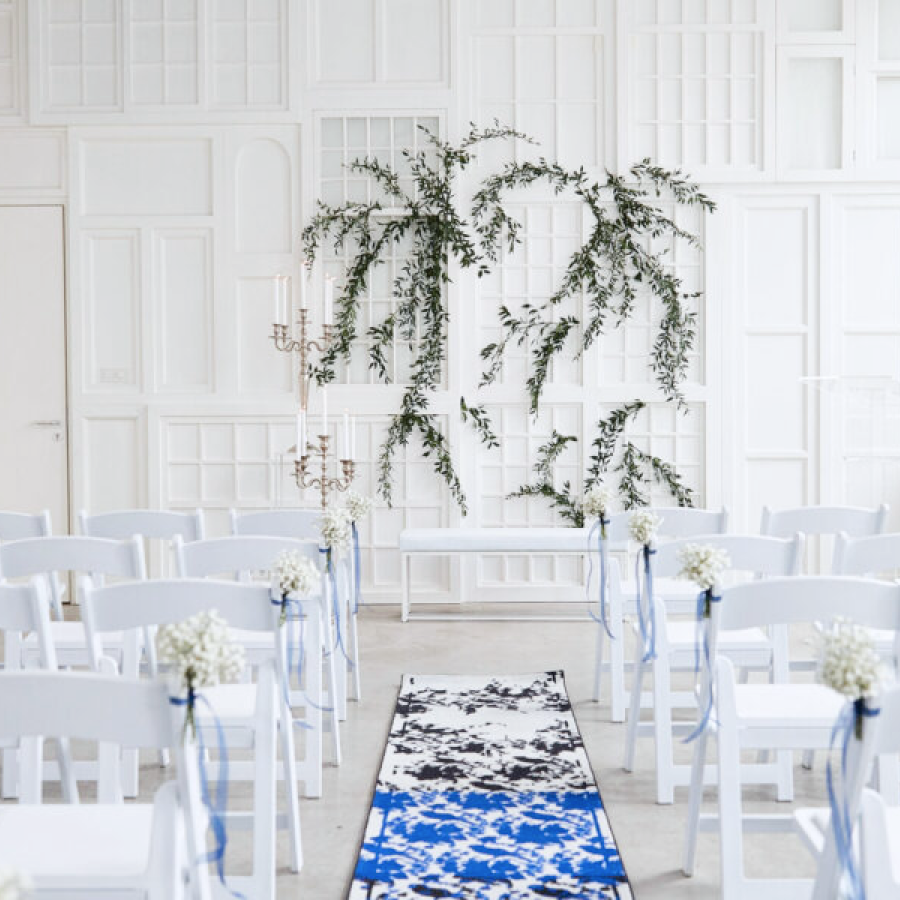
Yes. @droog holds Gemeente Amsterdam approval as an official wedding location. That means the registrar can come to the building to conduct your civil ceremony. You do not need to go to the registry office and then travel to a separate celebration venue. The legal ceremony and the event can happen in the same place.
a practical note before you start
Gemeente Amsterdam updates its requirements and fee schedules regularly. The information in this article reflects the process as understood at time of writing, but requirements for specific nationalities, documents and costs can change. Always verify current requirements directly at gemeente.amsterdam.nl or by calling Burgerzaken before submitting any documents.
The process is manageable. It is just paperwork with a deadline. Start early, collect documents methodically, and book your Burgerzaken appointment as soon as you have a rough date in mind.
Everything after that, the space, the food, the people, the light on the canal, that part is easier.