

how to get married in the center of amsterdam?

how to get married in the center of amsterdam

Getting married in Amsterdam is not complicated. Getting married in a place that actually means something, that is a little harder. The city has no shortage of venues. It has a shortage of places that feel like something other than a backdrop.

@droog is a building from 1641. It housed the Drapers’ Guild, then became a design gallery, then a hotel, a cafe, a theatre, a meeting space, and somewhere along the way a place where people started asking: could we get married here?

The answer is yes.

what makes amsterdam a good city to get married in

Amsterdam has around 250 kilometres of canals, more than 1,500 bridges, and a historic city centre that has been on the UNESCO World Heritage List since 2010. The canal belt, known as the Grachtengordel, was built in the 17th century and remains largely intact. That means the city you see when you get married here is not a reconstruction. It is the original.

Legally, getting married in the Netherlands as a foreign national is possible but requires preparation. You will need a certificate of no impediment from your home country, translated into Dutch or English by a sworn translator. The Amsterdam Civil Registry, the Stadsarchief or the municipality office, handles the registration. Most couples arrange the legal ceremony separately, often at the Westerkerk or the Stadhuis, and then hold their celebration somewhere that actually reflects who they are.

That second part, the celebration, is where @droog comes in.

a building that does not look like a wedding venue

That is not a problem. It is the point.

Most wedding venues spend a lot of effort looking like wedding venues. White tablecloths, chandeliers, neutral walls that go with anything. @droog looks like itself. A labyrinth of rooms, each with a different character, connected by a yellow hallway staircase and a garden that sits in the middle of the city centre. The building has been redesigned over decades by Renny Ramakers and the designers associated with Droog, a movement that began in 1993 with the idea that design should be honest, functional, and slightly unexpected.

That philosophy shows up in every room. The chandelier in the library is flat, hanging low over a long table surrounded by yellow chairs. The wallpaper is based on a painting from the Rijksmuseum. The theatre is entirely red, pink, orange and purple, with a round u-shaped tribune and movable cushions. The cafe has a blue butterfly lamp, a curved white tiled bar, and a fireplace. None of it was chosen to be inoffensive. All of it was chosen with a reason.

If you want a wedding that looks like every other wedding, this is probably not your building. If you want a wedding that looks like yours, keep reading.

the spaces available for your wedding at @droog
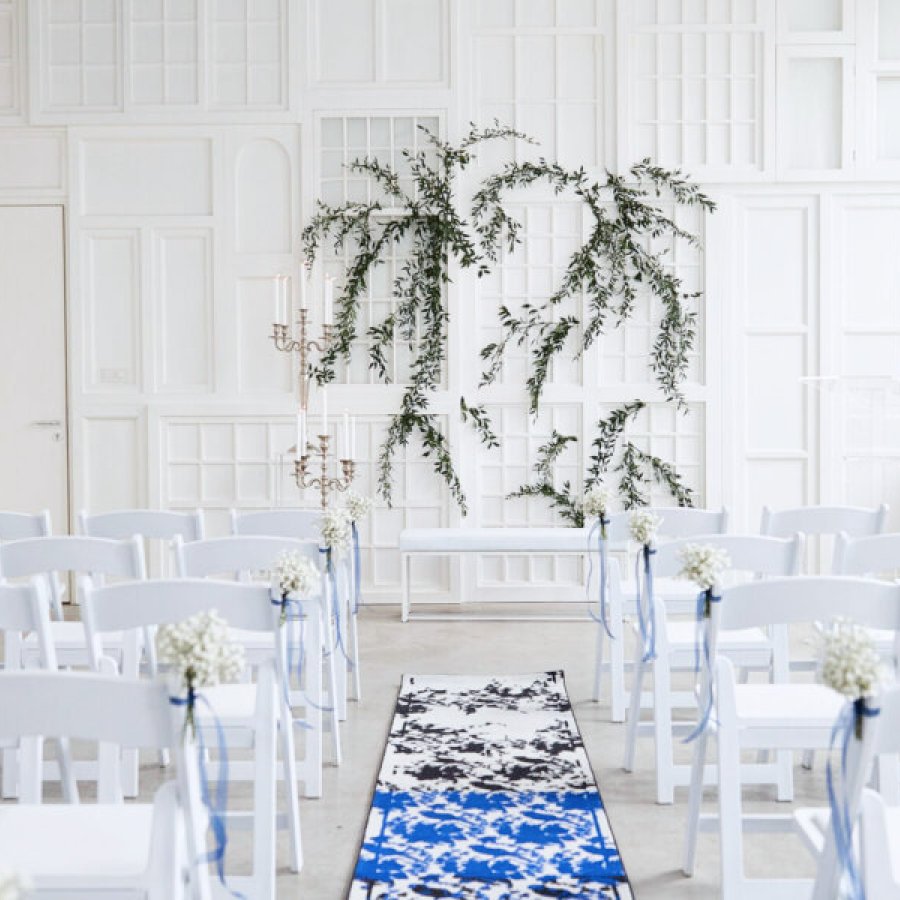
Wedding/trouwerij met blauwe loper in white space

The building has five distinct spaces. You can use one or several, depending on the size of your group and how you want the day to flow.

the cafe restaurant

The cafe is at the top of the yellow hallway staircase, overlooking the Groenburgwal canal. It is tall, bright, classical and cosy at the same time, which sounds like a contradiction until you see it. The blue butterfly lamp hangs above a room that fits up to 180 people standing or 70 people seated. There is a fireplace. There is a curved white tiled bar. There is a kitchen that has been serving the same idea since 2004, which is that food is worth sitting down for. For a wedding dinner or a reception with a view over the water, this is the room most couples start with.

the white space

The white space is upstairs. Large white windows look out onto the old Amsterdam houses surrounding the building and into the garden below. It fits up to 70 people in a theatre setting or 50 seated with tables, depending on the setup. It has a beamer. It is a room that has held a PhD promotion and a book launch in the same week. A wedding ceremony fits here just as well.

the red space

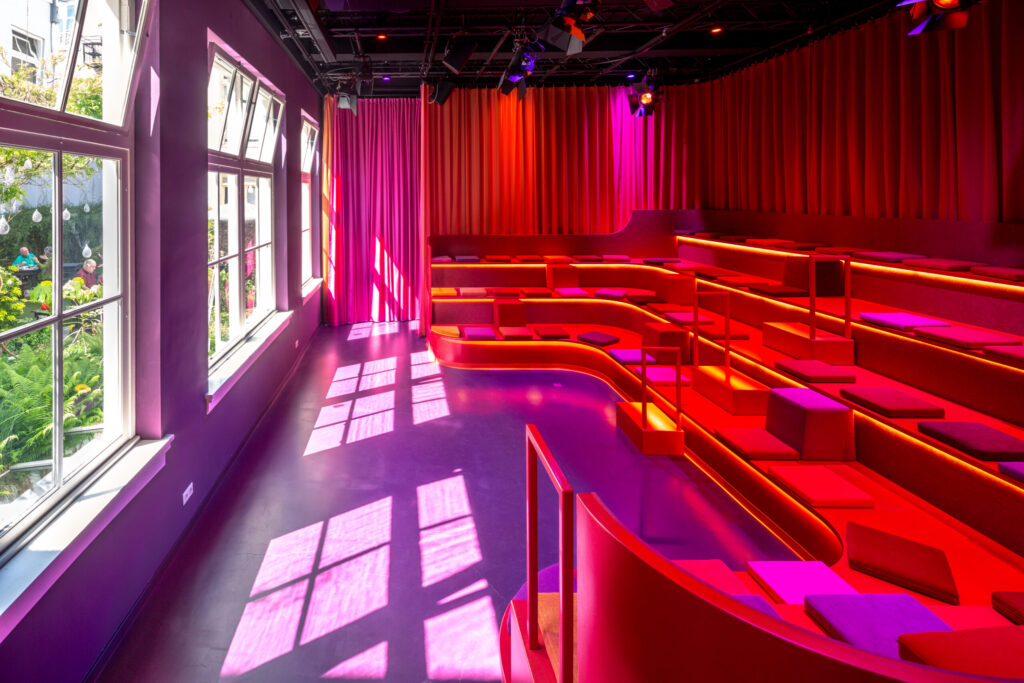
The red space is the theatre. Red, pink, orange, purple. A round u-shaped tribune with movable cushions that seats up to 80 people. It is equipped with professional theatre equipment, lighting, and sound. If you want your ceremony to feel like a performance, and some couples do, this is where that happens. Between 50 and 60 people sit comfortably. Fewer than 20 and the room starts to feel empty, so this one works best when the guest list is a real guest list.

the grand space
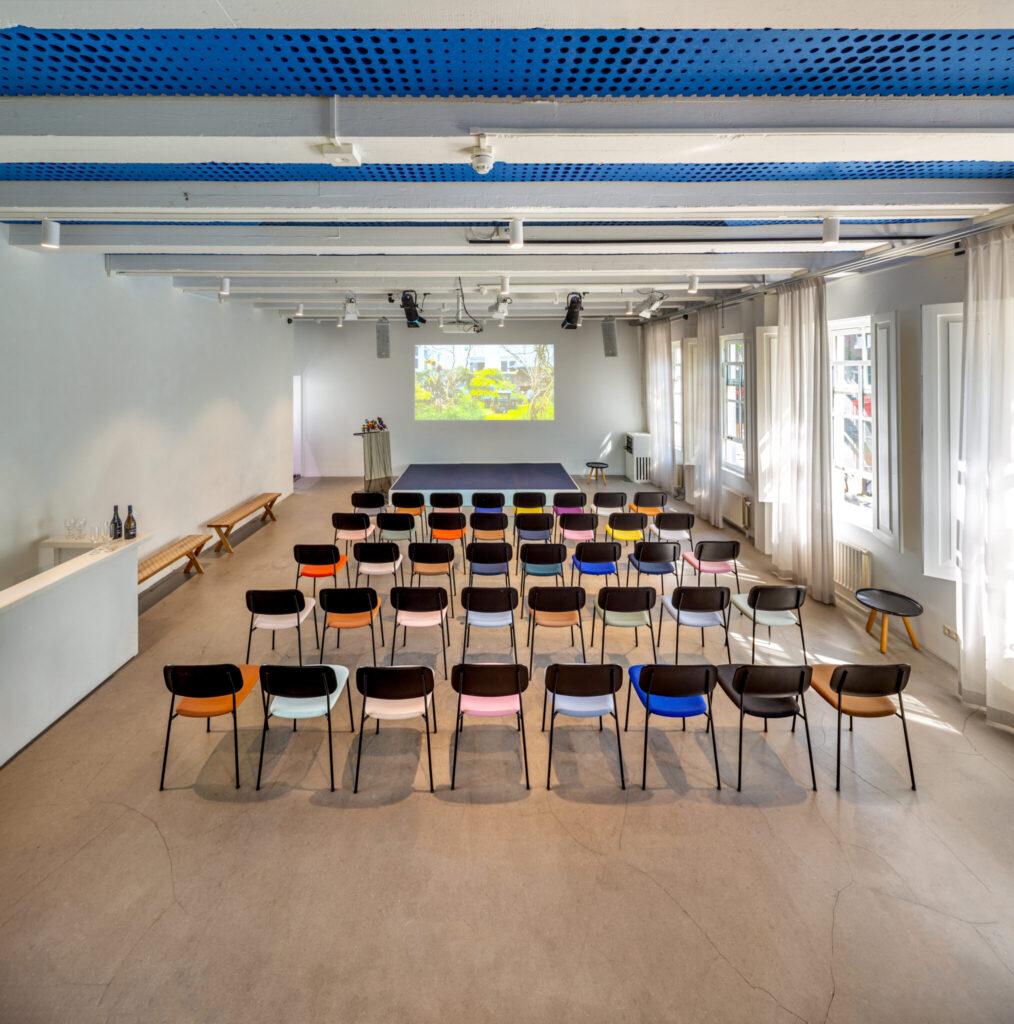
grand space in congres setting

The grand space is on the ground floor, with a giant sliding door that opens directly to the garden. It fits up to 90 people seated or 160 standing. There is a stage, a beamer, and a sound system. For larger receptions, networking drinks after a ceremony, or a party at the end of the night, this is the room that holds it all together. Charlotte Tilbury has used it for a pop-up. So has Shiseido. It works for a wedding too.

the library

Ten people around a long table. Yellow chairs, a flat chandelier, flowered wallpaper from a Rijksmuseum painting, windows looking into the garden. The library is the room for a private dinner for the inner circle, the night before or the morning after. Not a space for speeches. A space for a meal that matters.

the garden

A courtyard in the middle of the city centre. It connects the grand space to the red space and is visible from several rooms above. It seats 60. Nobody has ever asked for the address twice.

how a wedding day at @droog can look

There is no fixed format. That is also the point. But here is one way a day could flow, to make it concrete.

Guests arrive and gather in the grand space or the garden for drinks. The ceremony takes place in the white space, with chairs facing a window that looks out over old Amsterdam rooftops. Afterwards, the group moves to the cafe restaurant for dinner, canal view included. The library is reserved for the immediate family. Later in the evening, the grand space opens again for dancing or a late reception. The red space runs a short programme, a reading, a live set, something unexpected.

Rooms do not need to be used in isolation. @droog is a building, not a ballroom. You move through it. That is what makes it work for a full-day event.

food and drink

The cafe restaurant at @droog sources locally where possible. Sustainability is not a marketing claim here, it is built into how the kitchen operates. For weddings, the team can discuss a menu that fits the size and format of your event, whether that is a seated dinner, a standing reception, or a combination across multiple rooms. Tell them what you have in mind and they will tell you what is possible.

practical information

@droog is located on Staalstraat 7b in Amsterdam, directly on the Groenburgwal canal in the historic centre. The building is a 10-minute walk from Amsterdam Centraal and is accessible by public transport, bike, and foot. There is no on-site parking, which is fairly standard for this part of the city.

The building is available for private events on evenings and weekends, and sometimes during weekdays depending on programming. Capacity across all rooms combined reaches up to 180 people for a standing reception. For a seated dinner, the cafe restaurant and white space together accommodate around 120 people comfortably.

Events are not limited to one room. If you need a ceremony space, a dinner space, a breakout room and a garden, you can have all of them. It is one building and it has all of those things.

request quote

legal requirements for getting married in amsterdam as a foreigner

This is the part most guides skip over. Here it is, plainly.

To get legally married in Amsterdam, both partners need to be registered or submit documents to the Amsterdam municipality. The key documents are a birth certificate, a valid passport or ID, and a certificate of no impediment from your country of residence or citizenship. That certificate confirms you are legally free to marry. It needs to be translated into Dutch or English by a sworn translator if it is in another language.

The municipality has a processing time. Start this process at least three months before your planned date, ideally earlier if you are coming from outside the EU. Some countries require apostille stamps on documents. Check with your home country’s consulate in the Netherlands.

The legal ceremony itself, the part that makes it official, takes place at the Amsterdam municipality office or at a registered location. A venue like @droog can host the celebration. Whether it can host the legal ceremony depends on licensing, which is worth discussing directly when you make your inquiry.

Many couples opt for a civil ceremony at the municipality on the morning of the wedding and then hold the full celebration at @droog the same day. It is practical and it means the celebration can be exactly what you want it to be, without being structured around legal formalities.

is @droog the right venue for your wedding?

Honest answer: it depends on what you want.

If you want a venue with a wedding coordinator who has done 200 weddings and has a checklist for every contingency, @droog is not that. It is a design space with a strong point of view, a team that knows the building well, and a kitchen that cares about the food.

If you want a venue in the actual historic centre of Amsterdam, on a canal, in a building from 1641, with rooms that look like nothing else in the city, and a philosophy that treats every event as something worth thinking about rather than processing, then yes. @droog is the right venue.

It works best for couples who know what they want and want a space that can hold it. Not a blank canvas. A canvas with character, and enough room to make it yours.

frequently asked questions about getting married in amsterdam

can non-dutch citizens get married in amsterdam?
Yes. You need to submit the required documents to the Amsterdam municipality, including a certificate of no impediment from your home country. Start the process at least three months before the date.

how many people can @droog host for a wedding?
Up to 180 people for a standing reception across multiple spaces. Around 120 seated for a dinner, depending on which rooms are used. For smaller, more intimate weddings of 20 to 50 people, the white space or cafe restaurant work well on their own.

is there catering at @droog?
Yes. The cafe restaurant has its own kitchen and team. They work with local suppliers and can discuss a menu tailored to your event. For specific dietary requirements or large custom menus, it is best to discuss this early in the planning process.

can we hold the legal ceremony at @droog?
This depends on current licensing. Ask directly when you make your inquiry. Many couples hold the legal ceremony at the municipality and the celebration at @droog on the same day.

is the venue accessible?
The building is in a historic 1641 structure, which means some areas have stairs. Accessibility details are best confirmed directly with the team when discussing your event setup.

how far in advance should we book?
As early as possible, especially for weekend dates. The building hosts both public programming and private events, so availability is not guaranteed. For a specific date in peak season (May through September), six to twelve months ahead is a reasonable lead time.

is the garden available for weddings?
Yes. The garden is an outdoor courtyard that connects several rooms and fits up to 60 people. It is available as part of a larger event. Weather in Amsterdam being what it is, most couples treat it as a complement to indoor spaces rather than the main venue.

what is the address?
Staalstraat 7b, Amsterdam. On the Groenburgwal canal, 10 minutes on foot from Amsterdam Centraal.

tell us what you have in mind

Every wedding at @droog starts the same way: a conversation about what you actually want. Not a form with dropdown menus. A conversation. Tell the team the date, the number of people, and the rough shape of the day. They will tell you what is possible.

The building has held theatre performances, board meetings, pop-up stores, PhD promotions and dinners that went on longer than planned. A wedding fits. It always has.
request quote

im getting married! what do i arrange first?

i’m getting married. what do i arrange first?

Congratulations. Seriously. Now put the phone down for five minutes and let the news sink in before you open a single spreadsheet or wedding planning app.

Done? Good. Because the next thing most people do is Google everything at once and end up overwhelmed before they’ve even told their parents. This article is not that. It’s a practical, honest checklist of what actually needs to happen first, in roughly the right order, so you can move forward without losing your mind.

the one thing that drives every other decision

Your venue determines almost everything else. The date, the guest list size, the catering, the setup, the flow of the day. This is not an exaggeration. Experienced wedding planners say it every time, and couples who didn’t listen say the same thing in hindsight.

Before you book a florist, before you taste cake, before you buy a dress or a suit, know where you’re getting married. And ideally, know it soon. Good venues book out a year or more in advance, sometimes two.

So the real answer to “what do I arrange first” is: pick your venue. Everything else is a consequence of that decision.

but first, the conversation you actually need to have

Before any venue visit, sit down with your partner and talk through a few things. Not the colour of the napkins. The big ones.

  • Roughly how many people are we inviting?
  • What kind of atmosphere do we want? Formal dinner, relaxed gathering, something in between?
  • Do we want a ceremony and reception in the same place, or are we fine splitting them?
  • What is our actual budget, not our dream budget?
  • Are there any non-negotiables for either of us?

These questions sound obvious. Most couples skip them and end up in a venue that works for one of them and not the other. Twenty minutes of honest conversation now saves three months of confusion later.

what to look for in a wedding venue

Wedding/trouwerij met blauwe loper in white space

A wedding venue is not just a room. It’s the backdrop for photographs you’ll look at for decades, the space where your guests spend most of their time, and the frame around the whole day. These are the things that matter when you visit.

Capacity. Not just the number on the website. Ask how many people fit comfortably seated for dinner. Ask how it feels with 30 people in it on a quiet Tuesday. Ask whether the space looks empty below a certain number of guests. A room that holds 150 standing can feel cold and vast with 40 people sitting down to eat.

Layout and flow. Can people move easily between spaces? Is there room for a drinks reception while the dinner room is being set? Is the entrance practical? Where do people go when they need air?

Light. Natural light matters more than most people realise, for photos and for atmosphere. Visit during the time of day your event will actually run.

Sound. Is there a system already in place? Are there restrictions on music after a certain hour? Can the space handle a live band?

Kitchen and catering. Some venues have their own kitchen and team. Others require you to bring in external caterers. Both can work, but know which one you’re dealing with.

Flexibility. Can the space be configured in different ways? Does the team have experience adapting to last-minute changes?

@droog as a wedding venue in amsterdam

We don’t often lead with the word wedding. But the question comes up often enough that it’s worth being direct: yes, @droog hosts weddings, and yes, it suits them well.

The building dates from 1641. It housed the Drapers’ Guild. The rooms have been inhabited by designers, artists, and makers for decades, and that history shows in the materials, the furniture, and the way the light falls. It is not a neutral box. It is a place with character, which is exactly what some couples are looking for.

The white space is upstairs. Large windows look out onto the old Amsterdam houses and down into the garden. It holds up to 70 in theatre setting, or 50 seated with tables, depending on setup. It works for a ceremony, for a dinner, or for both in sequence.

The library is also upstairs. Ten people around a long table, yellow chairs, wallpaper based on a painting in the Rijksmuseum. It was designed as a meeting room. It works better as a private dinner table for the people who matter most.

The cafe is at the top of the yellow hallway staircase. Blue butterfly lamp, curved white tiled bar, a fireplace, views over the Groenburgwal canal. It holds 70 seated or 180 standing. Our most designed space, and arguably our most beautiful.

The grand space is on the ground floor, with a giant sliding door connecting it to the garden and to the red space. Up to 90 seated, 160 standing. The stage is there if you need it.

Rooms don’t have to be used one at a time. A ceremony in the white space, drinks in the garden, dinner in the cafe, dancing in the grand space. That’s a full day, entirely within the building.

request quote

the first twelve steps, in order

Here is a realistic sequence for the first few months after your engagement. Not a rigid timeline, but a logic you can follow.

1. Set a rough budget. You don’t need exact numbers yet, but you need a ceiling. Venue, catering, and photography typically take up the largest share. Know what you’re working with before you fall in love with anything.

2. Decide on a rough guest count. The difference between 40 guests and 120 guests is enormous in terms of which venues are even possible. You don’t need the final list yet. You need a realistic bracket.

3. Think about timing. Do you want to get married this year? Next year? In spring or summer? Saturdays in June book first. If flexibility on day or month saves you money or opens up options, that’s worth knowing early.

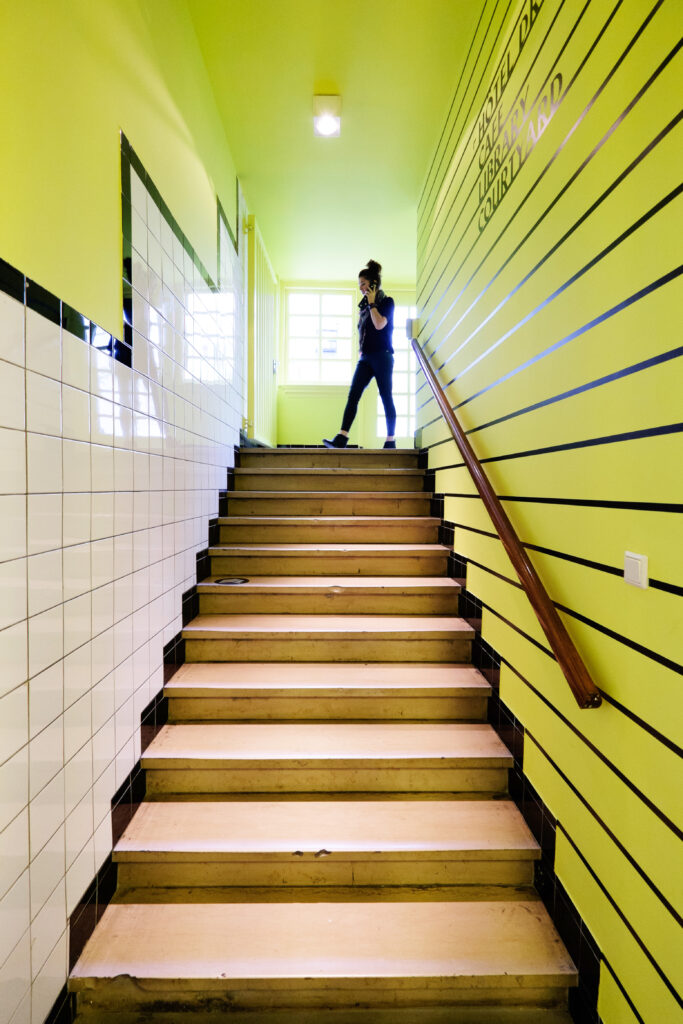
A yellow hallway thats leads to The Cafe

4. Research and shortlist venues. Three to five venues is enough for a first round. Read the details. Look at photographs. Notice what the venue is like on an ordinary day, not just in the styled shoot they put on their website.

5. Visit your shortlist. In person. Ask the questions above. Walk through the space. Talk to the person who would actually be your contact on the day, not just the sales team.

6. Book the venue. When you find the right one, commit. This unlocks everything else.

7. Set the date. Coordinate with any immediate family who absolutely need to be there. Then set it and move forward.

8. Book your photographer. Good photographers are booked out as far as venues. This is your second most time-sensitive booking.

9. Decide on catering. If your venue includes catering, organise a tasting. If you’re bringing someone in, start conversations now.

10. Send save-the-dates. Six to twelve months in advance for a larger wedding. Eight to ten weeks for a small one. This can be a simple email or a card. It doesn’t have to be elaborate.

11. Think about your legal requirements. In the Netherlands, you need to register your intent to marry with the municipality (gemeente) at least two weeks before the wedding, but arrangements often need to start earlier. If either partner is a non-Dutch national, check the requirements early.

12. Then, and only then, the rest. Flowers, invitations, hair and makeup, rings, music, the cake. These all matter. They just don’t need to happen in week one.

the mistakes people make early

Booking vendors before the venue. If the venue has its own caterer, your external caterer booking is useless. If the venue has a fixed date in mind that doesn’t match the availability you assumed, your florist’s calendar means nothing. Venue first, always.

Telling too many people too early and then incorporating their preferences. Two people are getting married. Two people’s opinions are the ones that count in every decision. Extended family and friends have feelings about venues and dates and menus. Those feelings are lovely and entirely beside the point.

Underestimating what things cost. The gap between a couple’s initial budget estimate and their actual spend is, statistically, very large. Caterers who see the word wedding on an enquiry form sometimes adjust their pricing accordingly. Ask for itemised quotes. Compare them. Ask what happens if guest numbers change.

Trying to do everything at once. Planning a wedding is a project with a long timeline. Trying to complete it in the first two months leads to decision fatigue and regret. The things that need to happen in month one are the big structural decisions. Everything else has time.

frequently asked questions

how far in advance should we book our venue?
For a Saturday in a popular city in peak season, 12 to 18 months is not unusual. For a midweek date or a smaller gathering, six to nine months is often enough. The safest approach: start looking as soon as you’ve settled on a rough guest count and a general time of year.

can we have both the ceremony and the reception at the same venue?
Yes, and it makes the day significantly smoother for guests. Not all venues can accommodate this depending on layout and licensing, so ask explicitly when you visit.

what’s the difference between a wedding planner and a venue coordinator?
A venue coordinator works for the venue and manages what happens within the building on your behalf. A wedding planner works for you and manages everything, including external vendors, logistics, and the day-of schedule. For a complex day with many moving parts, a planner is worth the investment. For a more contained event at a venue with good support, a coordinator is often enough.

do we need a rehearsal dinner?
Not necessarily. It’s common in some cultural traditions, less so in others. If you have a wedding party with a ceremony that involves coordinated movement, a brief run-through the day before helps. A full dinner attached to it is optional.

how many guests is considered a small wedding?
Roughly under 50. Under 30 is considered intimate. Under 15 is micro. The category matters less than knowing which one you’re planning, because venues, catering, and logistics scale very differently across those ranges.

is it possible to have a wedding at @droog?
Yes. The building has multiple spaces that can be combined or used separately, depending on the size and shape of your day. The team has experience with events of all kinds and can advise on what configuration works for your guest count and format. The best starting point is a conversation.

what’s the most overlooked cost in wedding planning?
Service charges and taxes on top of quoted prices. Corkage fees if you bring your own wine. Overtime charges if the event runs long. Transport between venues if you’re splitting your day across locations. These are not huge individually, but they add up quickly. Ask about them upfront.

do venues get booked faster on certain days or months?
Yes. Saturdays in May, June, and September are the most sought-after in the Netherlands. Friday evenings and Sundays are increasingly popular and often more available. January and February are quietest, which can mean better pricing and more flexibility.

one last thing

The wedding industry is very good at making you feel like you’re behind. You’re not behind. You’re just getting started. The decisions that matter most in the first month are the ones that create structure: a rough guest number, a realistic budget, and a venue that feels right. Everything else builds from there.

If you’re considering Amsterdam, and you want a space that has character without performing it, we’re happy to show you around and talk through what your day might look like here.

request quote

what are the best months to get married in amsterdam? wedding location for 100 persons in amsterdam

what are the best months to get married in amsterdam?

June. That is the short answer. But the longer one is more useful.

Amsterdam is a city that works in every season, but it rewards those who plan around its rhythms. If you are looking for a wedding location for 100 persons in Amsterdam, the month you choose shapes everything: the light through the windows, the temperature in the garden, the availability of the spaces you actually want. This guide covers the best months, what each season gives you and what it costs you, and what to look for in a venue that fits a group of around 100 people.

the best months, ranked

Amsterdam has around 1,800 hours of sunshine per year, clustered between April and September. Within that window, not all months are equal.

June and early July are the clear peak. Average temperatures sit between 17 and 22 degrees Celsius. Daylight stretches past 9 PM. Canal reflections at golden hour look the way they do on every postcard you have ever seen. Demand for venues is at its highest, so booking 9 to 12 months in advance is not unusual for a group of 100.

May is the underrated option. The city is less crowded than July or August. Tulip season runs into early May in the region, which matters if your wedding photography extends beyond the venue. Temperatures average 14 to 18 degrees. Rain is possible but rarely heavy.

Late August and September offer warmth without the peak-summer pressure. September in particular has a quality of light that photographers talk about: lower sun, longer shadows, richer colour. Venue availability opens up again after the summer rush.

April is a gamble that sometimes pays off. It can be 20 degrees and dry. It can also be 10 degrees and wet. If you plan an outdoor element, build in a covered alternative.

October works well for a more intimate or interior-focused celebration. The city empties of tourists, canal water reflects autumn colours, and venues are often more flexible on date and setup. Not ideal if your ceremony depends on an open garden.

Winter months, November through February, bring short days and cold. But Amsterdam in December has its own logic: candlelight, dark water, long dinners. A venue with a fireplace becomes a different proposition entirely.

what changes with the season

Beyond temperature, three things shift depending on the month you choose.

First, price. June and July command premium rates from venues, caterers and photographers. Shoulder months like May and September offer the same city for less.

Second, daylight. A June wedding at 6 PM has three hours of golden-hour light before dusk. An October wedding at 6 PM is already dark. That changes the rhythm of the day entirely.

Third, the city itself. Amsterdam in summer is full. Hotels are expensive and often pre-booked. Your guests arriving from abroad will compete with three million annual tourists for accommodation. September and May put you in the same beautiful city with significantly less friction.

what to look for in a wedding location for 100 persons in amsterdam

Wedding/trouwerij met blauwe loper in white space

A group of 100 people is not a small gathering. It is not a private dinner. It sits at a size where layout decisions matter: how people move between spaces, where the ceremony happens versus the dinner, whether there is a room for the couple to step away from the crowd for a moment.

Here is what to check before you commit to a venue.

  • Seated capacity versus standing capacity. Many venues list 100 standing and then seat 60. Know which number applies to your format.
  • Ceremony and reception in one location. Moving 100 people across the city between ceremony and dinner is logistically difficult and often unnecessary. Look for a venue with at least two usable spaces.
  • Catering flexibility. Some venues require you to use their caterer. Others allow external chefs. Know which applies before you fall in love with a space.
  • Sound and technical equipment. Speeches, live music and a DJ all have different requirements. Check what is already installed.
  • Accessibility. Stairs are common in Amsterdam canal houses. For a group of 100, at least one accessible route matters.
  • A garden or outdoor element. Not required, but it changes the mood of the day entirely if the weather cooperates.

@droog as a wedding location for 100 persons

@droog is a building from 1641 on the Groenburgwal canal in the centre of Amsterdam. It was home to the Drapers Guild. It has been a design space, a gallery, a hotel and a restaurant. It is now one of the more interesting event venues in the city, partly because it does not look or feel like an event venue.

The building has five distinct spaces, each with its own character. For a wedding of around 100 people, the most logical combination is the white space, the grand space and the garden. But there are other configurations depending on your format.

the spaces, room by room

Rode ruimte (The Red Space) met de gordijnen open.

The grand space is on the ground floor, with a giant sliding door that opens directly onto the garden. It seats up to 90 people or fits 160 standing. It has a stage, a beamer and a sound system. Ceremonies, plenary sessions, drinks receptions and dinners have all happened here. It is also where Charlotte Tilbury and Shiseido put their pop-up stores, which gives you some sense of the scale and the light.

The white space is upstairs. Large white windows look out over the Amsterdam canal houses and down into the garden. It seats 70 in a theatre layout or 50 with tables. For a wedding ceremony with 60 to 70 seated guests, this room works well. The light is the detail that makes it: north-facing and steady throughout the day.

The red space is the theatre room. Completely red, orange and purple, with a u-shaped tribune and all the technical equipment of a professional stage. It seats up to 80, though 50 to 60 feel more comfortable. For a ceremony with a performative element, a live musician or a reading, this room has a presence that a hotel ballroom simply does not.

The library seats 10 around a long table. Flowered wallpaper based on a Rijksmuseum painting. Yellow chairs. A flat chandelier. This is the room you book for the couple, the immediate family or a private dinner for ten. Not for the full group of 100.

The cafe restaurant is at the top of the yellow hallway staircase, with a view over the Groenburgwal canal. Blue butterfly lamp, a curved white-tiled bar, a fireplace. It seats 70 or fits 180 standing. For a wedding dinner that wants to feel less like a banquet and more like a very good evening, this room delivers that.

Events at @droog are rarely limited to one space. A ceremony in the white space, drinks in the garden, dinner in the cafe restaurant: that is a full wedding day without leaving the building.

request quote

the garden

A courtyard in the middle of the city centre. It has windows from four other rooms looking into it. It seats 60. For a June or September wedding, the garden changes the entire feel of the day: arrivals, drinks, photographs, a moment away from the crowd. It is the detail that is hardest to find in central Amsterdam and easiest to take for granted once you have it.

design as a backdrop

@droog is rooted in Droog Design principles. That is not a marketing phrase. It means the furniture, the fittings and the details have been chosen with deliberate reasoning. The Tejo Remy chest of drawers made from salvaged wood sits in the gallery. The butterfly lamp in the cafe was designed by Demakersvan. The flowered wallpaper in the library is based on a Jan van Huysum painting from the Rijksmuseum. None of these things are decoration. They are the point.

For a wedding, that matters more than it might seem. Your guests spend four to eight hours in a space. A space that gives them something to look at, something to talk about and something to remember is a different kind of hospitality than a neutral room with white tablecloths.

sustainability at the venue

Sustainability is part of the building’s identity, not an add-on. Local sourcing is prioritised in the kitchen. The building itself has been constructed and maintained with environmental responsibility in mind. If your wedding has a sustainability policy, @droog is a venue that supports it rather than contradicts it.

frequently asked questions

What is the best month to get married in Amsterdam?
June offers the best combination of warmth, daylight and reliable weather. May and September are strong alternatives with fewer crowds and more venue availability.

How far in advance should I book a wedding venue in Amsterdam for 100 people?
For June and July, 9 to 12 months is realistic. For shoulder months like May, September and October, 6 to 9 months is usually sufficient. The earlier you confirm, the more flexibility you have on catering and setup.

Can a wedding of 100 people fit in one venue in Amsterdam?
Yes, but the format matters. A seated dinner for 100 requires a different room than a ceremony for 100, which requires a different layout again. The venues that handle this best are those with multiple connected spaces, so ceremony, drinks and dinner can each have their own setting without relocating the group.

Does @droog do civil weddings?
The spaces at @droog can be configured for a civil ceremony. For legal registration, you will need to coordinate with Amsterdam’s municipality (Gemeente Amsterdam), which authorises officiants. @droog can host the ceremony itself and everything that follows.

Is the venue accessible for guests with mobility requirements?
The ground floor spaces, including the grand space and the garden, are accessible. The upper spaces involve stairs. This is worth discussing during your site visit so the layout can be planned accordingly.

Can we bring our own caterer?
This is something to discuss directly with the @droog team. The cafe restaurant has its own kitchen and service. Depending on the format of your event, different arrangements are possible.

What happens if it rains on the day?
The grand space and the cafe restaurant both offer indoor coverage for the full group of 100. The garden is a bonus when the weather cooperates, not a dependency. A good venue plan always has an indoor alternative that works on its own terms.

Is @droog only for design-industry weddings?
No. The building attracts people who want something that does not look like every other event venue in Amsterdam. That covers a wide range of couples and a wide range of wedding formats. The design is a backdrop, not a theme you have to match.

practical considerations for a wedding of 100 in amsterdam

A few things that are easy to overlook when planning a wedding in Amsterdam specifically.

Guest accommodation. The city centre has hundreds of hotels within walking distance of most venues, but availability in June and July fills quickly. Send accommodation suggestions to guests at least three months before the date.

Transport. Amsterdam’s centre is compact. Many guests will walk or cycle between locations. For those arriving from outside the city, Centraal Station is 10 minutes by taxi from the Groenburgwal area.

Photography. The canal at Groenburgwal, the narrow streets around the building and the garden itself are all usable without a permit. For photography on bridges or in Vondelpark, permits are sometimes required. Check in advance.

Sound restrictions. Amsterdam has noise ordinances that affect outdoor amplified sound after a certain hour. Know the cutoff time for any outdoor music or speeches in the garden.

The week of the event. Amsterdam hosts large festivals and events throughout the summer. King’s Day is 27 April. Pride Amsterdam runs in late July or early August. Both affect hotel pricing and canal access. Neither is a reason to avoid those dates, but they are worth knowing about.

why the venue matters as much as the month

The best month in Amsterdam cannot compensate for a venue that feels like a function room. And the right venue makes a less-than-perfect weather day irrelevant.

What a venue for 100 people needs to do is give the day a sense of place. Not just a room, but a building with a history, a logic, a reason to be there. @droog has been on the Groenburgwal since 1641. It has held everything from guild meetings to theatre performances to board meetings in the same week. A wedding fits that history well.

The spaces are different enough from each other that a full day of events, ceremony, drinks, dinner and a late evening, each feel distinct. That is harder to achieve than it sounds in a city centre building. Most venues give you one large room with movable partitions. @droog gives you five rooms with five different characters and a garden connecting them.

If you are planning a wedding in Amsterdam for around 100 people and you want a space that earns its place in the day rather than just housing it, this is worth a visit.

request quote