

5 tips voor een goede planning tijdens mijn event

5 tips voor een goede planning tijdens jouw event
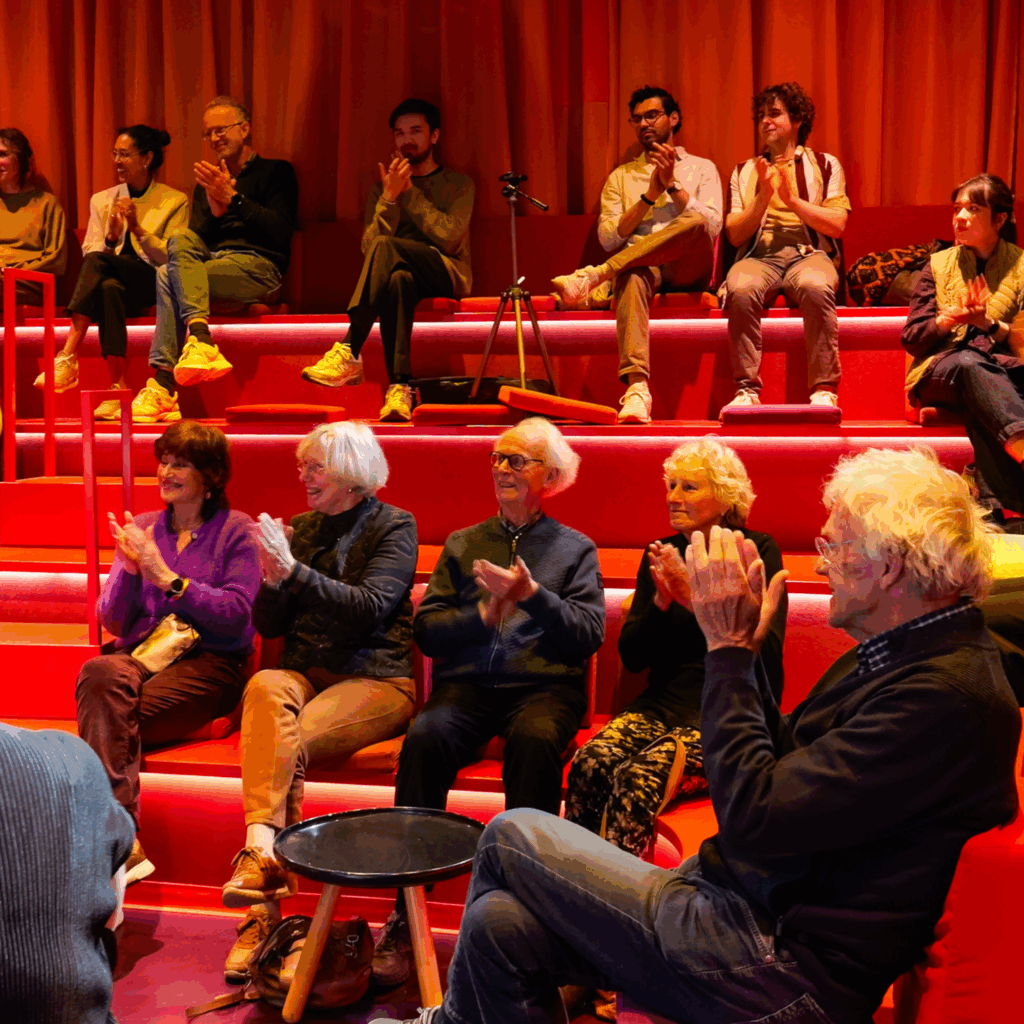
event in de red space met bezoekers

Een goed event begint lang voor de dag zelf. Niet met een moodboard of een thema, maar met een eerlijke vraag: wat moet er eigenlijk gebeuren, en in welke volgorde? De planning is het onzichtbare skelet van elke geslaagde dag. Als die klopt, merkt niemand het. Als die niet klopt, merkt iedereen het.

Hieronder vijf tips die je helpen om structuur te brengen in je voorbereiding. Geschreven vanuit wat wij bij @droog dagelijks zien werken, en wat niet.

tip 1: begin met het einde

De meeste organisatoren beginnen bij het begin. Dat is begrijpelijk, maar het is niet altijd slim. Begin liever bij de vraag: wat moet een deelnemer aan het einde van dit event hebben meegekregen? Een inzicht, een beslissing, een gevoel, een netwerk? Zodra dat helder is, vallen de keuzes daarvoor veel makkelijker op hun plek.

Stel dat het antwoord is: mensen moeten met elkaar in gesprek zijn gegaan over een lastig vraagstuk binnen het bedrijf. Dan weet je al dat je geen podiumsessie van anderhalf uur nodig hebt, maar kleinere gespreksformaten, ruimte voor beweging en een plek waar mensen informeel kunnen doorpraten. Dat vraagt een andere opstelling, een andere ruimte, en een ander programma dan een standaard conferentie.

In de praktijk: schrijf aan het begin van je planning letterlijk op wat het gewenste eindresultaat is. Één zin. Alles wat je daarna plant, toets je aan die zin.

tip 2: kies je ruimte vóórdat je je programma vastlegt
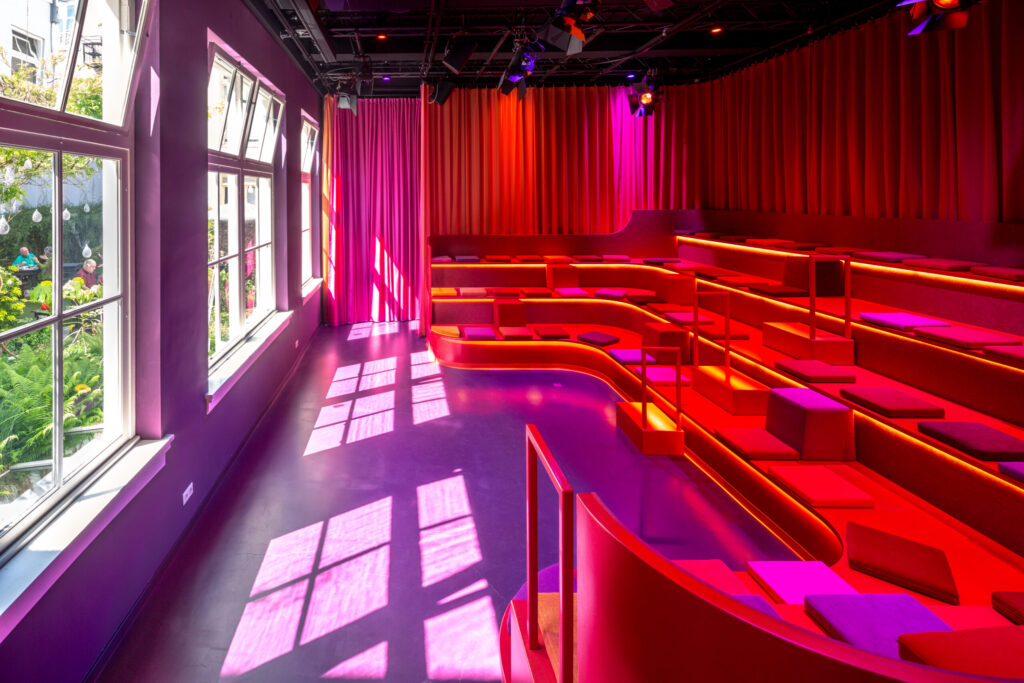
Rode ruimte (The Red Space) met de gordijnen open.

Dit klinkt logistiek, maar het is inhoudelijk. De ruimte bepaalt mede het gedrag van je deelnemers. Een theateropstelling maakt van mensen een publiek. Een ronde tafel maakt van mensen gesprekspartners. Een netwerkborrel in een grote hal maakt van mensen passanten.

Bij @droog hebben we meerdere ruimtes die stuk voor stuk een andere dynamiek meebrengen. The grand space op de begane grond heeft een schuifdeur naar de tuin en past tot 90 mensen zittend of 160 staand. Goed voor plenaire sessies, lezingen, pop-up stores of een borrel aan het einde van een dag. De ruimte heeft een podium en een geluidssysteem.

The red space is ons theatrale hart. Rood, roze, oranje, paars. Een u-vormige tribune met beweegbare kussens voor maximaal 80 mensen, al voelt 50-60 comfortabeler. Minder dan 20 mensen en de ruimte voelt leeg. Dit is de ruimte voor shows, pitches, panelgesprekken of alles wat een theatrale setting vraagt.

Boven vind je the white space, met grote witte ramen die uitkijken op de Amsterdamse grachtenpanden en de tuin. Tot 70 mensen in theateropstelling, 50 zittend met tafels. Goed voor trainingen, workshops, vergaderingen op grotere schaal, of een boeklancering.

The library is onze meest intieme ruimte. Gele stoelen, een lange tafel, behang gebaseerd op een schilderij uit het Rijksmuseum en een plat luchter plafond. Maximaal 10 mensen aan tafel. Niet meer. Ideaal voor besloten vergaderingen of een privédiner.

En dan is er nog the cafe bovenaan de gele trap. De blauwe vlinderlamp, de bar met witte tegels, het haardvuur. Tot 70 mensen zittend, 180 staand. Misschien wel onze mooiste ruimte, met uitzicht op de Groenburgwal.

De tip: reserveer je ruimte niet op capaciteit alleen, maar op wat de ruimte doet met mensen. En weet dat je bij @droog ruimtes kunt combineren. Breakout-sessies, dinners, trainingen en borrels kunnen tegelijkertijd op verschillende verdiepingen plaatsvinden.

tip 3: bouw buffers in, niet als optie maar als vaste regel

Elk event heeft een tijdlijn. Sprekers, catering, techniek, aankomst. En elk event loopt ergens uit. Dat is geen probleem als je dat had voorzien.

Een buffer is niet hetzelfde als leegte. Het is de ruimte die je deelnemers nodig hebben om een gesprek af te maken, nog even naar het toilet te gaan, of om van de ene ruimte naar de andere te lopen zonder te rennen. Een programma zonder buffers is een programma dat achterloopt vanaf het eerste moment dat iemand te laat aankomt.

Praktische vuistregels:

  • Plan na elke sessie van meer dan 45 minuten minimaal 10-15 minuten vrij.
  • Reken bij catering altijd op 15 minuten extra aanlooptijd. Mensen eten en drinken niet op commando.
  • Plan de eerste buffer in direct na het welkom. De aanloop duurt bijna altijd langer dan gepland.
  • Bouw aan het einde van de dag een zachte landing in, geen harde stop. Mensen die nog willen doorpraten verdienen die ruimte.

Een buffer is ook een signaal aan je deelnemers: we hebben niet elke minuut volgestopt. Er is ruimte om te ademen. Dat gevoel is onderdeel van de ervaring.

tip 4: maak een technisch draaiboek naast je programma

Het programma is voor je deelnemers. Het draaiboek is voor jou en je team. Ze zijn niet hetzelfde.

Een technisch draaiboek bevat alles wat er achter de schermen moet gebeuren om het programma te laten kloppen. Denk aan: wanneer wordt de beamer aangezet, wie ontvangt de catering, welke microfoon gaat naar welke spreker, wie opent de schuifdeur naar de tuin, wanneer wordt de tafel in the library klaargemaakt voor het diner.

Schrijf dit draaiboek in kolommen. Tijdstip, actie, verantwoordelijke. Niet meer dan dat. Hoe helderder het document, hoe minder vragen er op de dag zelf gesteld worden.

Deel het draaiboek van tevoren met iedereen die een rol heeft, inclusief de locatie. Bij @droog werken we graag mee aan het opstellen van zo’n document. Wij kennen de ruimtes, de routes, de logistiek. Een gezamenlijk draaiboek voorkomt miscommunicaties die anders pas op de dag zelf aan het licht komen.

Een goed draaiboek bevat ook een spoedcontact voor elke partij. Techniek loopt soms mis. Een spreker komt toch later. De catering is vertraagd. Als je weet wie je waarvoor belt, lost dat in 90% van de gevallen zichzelf op binnen vijf minuten.

tip 5: evalueer vóórdat je het event vergeet

Dit is de tip die het vaakst wordt overgeslagen, omdat hij aan het einde van een lange dag valt. Maar de evaluatie is het moment waarop je leert wat je bij het volgende event beter kunt doen.

Doe het in twee stappen:

Stap één: de dag zelf, binnen een uur na afloop. Schrijf op wat er niet liep zoals gepland. Niet om schuldigen aan te wijzen, maar om patronen te zien. Was de ruimte te krap voor de groep? Liep de catering uit? Hadden deelnemers moeite om de ruimte te vinden? Dit is verse informatie. Morgen weet je het niet meer zo precies.

Stap twee: een week later, als de emotie wat gezakt is. Bekijk het draaiboek en de planning opnieuw. Waar zaten de structurele knelpunten? Was het programma te vol? Was de ruimtekeuze goed? Hadden deelnemers genoeg tijd voor informele contacten?

Een korte enquête onder deelnemers helpt ook. Drie vragen, niet meer. Wat vond je goed? Wat had beter gekund? Zou je terugkomen? De antwoorden zijn vaak verrassend direct en bruikbaar.

Bij @droog horen wij graag hoe een event is verlopen. Niet uit beleefdheid, maar omdat het ons helpt om de volgende keer nog beter mee te denken.

hoe @droog helpt bij de planning

Een locatie is meer dan vier muren en een beamer. Wij denken mee over de structuur van jouw dag. Welke ruimte past bij welk moment in het programma? Wanneer is de combinatie van twee ruimtes slimmer dan één grote? Wat vraagt jouw publiek aan opstelling, licht, catering en routing?

@droog is in 1993 ontstaan vanuit een designfilosofie die vraagt waarom iets zo gedaan wordt als het altijd zo gedaan wordt. Die vraag stellen wij ook bij events. Niet om het ingewikkelder te maken, maar om het beter te maken.

Duurzaamheid speelt daarin mee. De catering die wij serveren komt zoveel mogelijk van lokale leveranciers. Het gebouw zelf, gebouwd in 1641 als gildehuis, is ingericht met oog voor materiaalgebruik en hergebruik. Wat je ziet, is niet toevallig gekozen.

Zit je nog in de planningsfase en wil je sparren over opzet, ruimtekeuze of programma? Vertel ons wat je in gedachten hebt.

request quote

veelgestelde vragen over eventplanning bij @droog

hoe ver van tevoren moet ik mijn event plannen?

Voor een event met meerdere ruimtes, catering en een volledig programma raden wij aan om minimaal zes tot acht weken van tevoren te beginnen. Voor kleinere meetings in bijvoorbeeld the library is vier weken vaak voldoende. Beschikbaarheid van ruimtes speelt daarin een rol, dus hoe eerder je contact opneemt, hoe beter.

kan ik meerdere ruimtes combineren tijdens één event?

Ja. Dat is juist een van de sterkste kanten van @droog. Je kunt een plenaire sessie in the grand space combineren met breakout-sessies in the white space en the library, en een diner in the cafe. Wij helpen je de logistiek en routing in het draaiboek te verwerken.

hoe groot mag mijn groep zijn?

Dat hangt af van de ruimte. The grand space past 90 mensen zittend of 160 staand. The cafe past 70 zittend of 180 staand. The red space heeft een tribune voor maximaal 80 mensen. The white space past 70 in theatervorm of 50 zittend met tafels. The library is voor maximaal 10 mensen. Bij combinaties van ruimtes kunnen grotere groepen goed worden gefaciliteerd.

wat als mijn programma tussentijds verandert?

Dat gebeurt. Een spreker valt weg, een sessie duurt langer. Zorg altijd voor een contactpersoon op locatie die beslissingen kan nemen. Een goed draaiboek met buffers geeft je de ruimte om bij te sturen zonder dat deelnemers het merken.

bieden jullie ook catering aan?

Ja. Ons cafe restaurant verzorgt catering voor events. We werken met lokale leveranciers en stemmen het aanbod af op het programma en de groepsgrootte. Of het nu gaat om een lunchdienst, borrelplateau of een volledig diner, vertel ons wat je nodig hebt.

is er technische ondersteuning aanwezig?

The grand space, the red space en the white space zijn uitgerust met beamers en geluidsapparatuur. Voor complexere technische opstellingen werken we samen met externe technici. Bespreek dit bij je boeking zodat we alles van tevoren kunnen afstemmen.

wat maakt @droog anders dan andere eventlocaties in Amsterdam?

@droog is geen neutrale huurruimte. Het gebouw heeft een geschiedenis, een designcultuur en een standpunt. Elk detail in het pand is bewust gekozen. Dat merk je als gast. Mensen verlaten een event hier met meer dan alleen een agenda die is afgewerkt. Dat is wat wij nastreven.

tot slot

Een goede eventplanning is geen checklist die je afvinkt. Het is een manier van denken. Begin bij het doel, kies je ruimte bewust, bouw buffers in, maak een technisch draaiboek en evalueer nadat het stof is neergedaald. Die vijf stappen maken het verschil tussen een dag die loopt en een dag die beklijft.

Wil je weten hoe @droog jouw volgende event kan ondersteunen? We denken graag mee.

request quote

5 tips for good planning during my event

5 tips for good planning during your event

Planning an event sounds simple until you’re standing in the middle of it. The catering runs late. The AV setup takes twice as long as expected. Someone forgot to brief the speaker on timing. Good event planning isn’t about having a perfect script. It’s about knowing where things go wrong, before they do.

These five tips come from what we’ve learned at @droog, running B2B events in a building from 1641 that has hosted everything from theatre performances to panel discussions to private dinners for ten. Design thinking is at the core of everything we do here, and that includes how we think about time, space and flow.


tip 1: start with the flow, not the programme

Most event planners start by filling a schedule. What time does the keynote start? When is lunch? That’s the wrong order.

Start with movement. How do people enter? Where do they go first? What does the transition from one part of the event to the next actually look like, physically? A programme on paper doesn’t tell you that the walk from registration to the main room takes four minutes, or that the corridor bottlenecks when 80 people try to move at once.

At @droog, the grand space on the ground floor connects directly to the garden and the red space. That’s not a coincidence. It means that during a break, people naturally spread out without being directed. Flow is designed into the building. For your event, the same principle applies: design the movement before you design the agenda.

A practical method: walk the entire event yourself before the day. Enter through the front door. Move through every space in the order guests will. Note every moment where people might cluster, get confused, or have to wait. Fix those moments, not with instructions, but with layout.

  • Draw a simple floor map with arrows showing guest movement
  • Mark every transition point (registration to welcome, welcome to session, session to break)
  • Add realistic time buffers to each transition, at least five minutes per move for groups over 30
  • Brief your team on flow, not just on tasks

tip 2: match the space to the purpose, not the headcount

Rode ruimte (The Red Space) met de gordijnen open.

The most common planning mistake isn’t picking a space that’s too small. It’s picking a space that fits the number but not the energy.

A room that seats 80 feels very different with 20 people in it. The red space here is a good example of this: its u-shaped tribune seats up to 80, but when fewer than 20 people are sitting on it, the space reads as empty. That changes the energy of whatever you’re trying to do. For a small group, you’d want the theatre feeling of a full room, which means either filling the seats or choosing a different space entirely.

The principle: a space should feel right for the number of people in it, not just accommodate them. Too large and there’s no tension, no focus. Too small and people get restless. The sweet spot is a room where the capacity feels slightly full, where there’s enough proximity that conversation happens naturally but enough room that people don’t feel crowded.

Questions to ask when matching space to purpose:

  • What energy does this session need? Intimate or expansive?
  • Does the layout encourage the behaviour you want (conversation, focus, participation)?
  • Will the room feel full or empty at your actual guest count?
  • Does the space signal the right thing? A boardroom signals formality, a design space signals open thinking

Different sessions often need different spaces. A morning keynote for 90 people, a breakout for 15, a working lunch for 30: those are three different rooms with three different setups. Events don’t have to live in one space.


tip 3: brief every supplier on the same timeline, with the same document

Miscommunication between suppliers is one of the leading causes of event delays. The caterer thinks setup starts at 13:00. The AV team thought it was 12:00. The venue coordinator has 11:30 in her notes. All three are working from separate conversations, separate emails, and separate assumptions.

One document. Every supplier. Updated in real time.

This doesn’t need to be complex. A shared spreadsheet with columns for time, action, responsible party and status is enough. What matters is that every person working on your event is looking at the same source of truth. When something changes, it changes in one place, and everyone sees it.

At @droog, events sometimes run across multiple rooms: a plenary in the grand space, breakouts in the white space, a private dinner in the library, drinks in the cafe. Each of those spaces has its own setup requirements, its own timing, its own team. A single shared runsheet is the only way to keep that from becoming four separate events happening in parallel without coordination.

What your runsheet should include:

  • Load-in and setup times per supplier, per space
  • Sound check and tech rehearsal slots (never skip these)
  • First guest arrival time, with 15 minutes of buffer before it
  • Session start and end times, with hard stops marked clearly
  • Break durations, catering delivery moments, Q&A slots
  • Load-out and cleanup responsibilities
  • Emergency contacts for every key person

Send this document to every supplier no later than five days before the event. Review it together in a 30-minute call. Then don’t touch it, unless something genuinely changes.


tip 4: protect your transitions

Sessions run long. Lunch takes longer than planned. A speaker has three more minutes of material. These things happen at every event. The question isn’t whether transitions will be disrupted. It’s whether you’ve protected them enough to absorb the disruption.

The answer is usually buffer time. Not five minutes between a 60-minute keynote and a 60-minute workshop. Fifteen. Because the keynote ran eight minutes over, the moderator asked two follow-up questions, and 70 people need to walk from one room to another, find their name on a table, and settle in before the next session can start.

There’s a specific kind of transition that planners consistently underestimate: the technical transition. Switching from one presentation to another, resetting a room layout, connecting a new speaker’s laptop to the AV system. Each of these takes time. At minimum, add ten minutes of technical buffer for every major setup change during your event.

A checklist for protecting transitions:

  • Add 10 to 15 minutes between every major session
  • Assign one person as timekeeper, with authority to interrupt speakers when time is up
  • Pre-load all presentations on one device, not each speaker’s own laptop
  • Test every AV switch during the tech rehearsal, not on the day
  • Have a contingency plan for the session that will definitely run long

Good transitions are invisible. Nobody notices them. Bad transitions are memorable for all the wrong reasons.


tip 5: design the end as carefully as the beginning

Most events are planned from the front. Registration is detailed, the opening is rehearsed, the first hour is tight. Then somewhere around the midpoint, the plan gets vaguer. By the time you reach the closing session, you’re improvising.

The end of your event is what people remember. Not because memory works that way by accident, but because endings carry emotional weight. A strong close, a clear moment of completion, a last impression that lands well: these are what guests take home. A weak ending, an event that just stops rather than concludes, leaves people with a vague sense of incompleteness.

Design the last 30 minutes as carefully as you designed the first 30. This includes:

  • A defined closing moment, not just the last session ending
  • A clear signal that the formal programme is done
  • Something for people to take with them, literally or conceptually
  • A plan for what happens next: drinks, departure, networking
  • A thank you that names the people who made it happen

At @droog, we’ve seen events close with a drink in the garden, a shared meal in the cafe, and a final round of discussion that moved from the grand space to the library as numbers dwindled. None of those were accidents. They were planned.

One more thing: brief your team on the close as specifically as you brief them on the open. Who dims the lights? Who signals catering to start clearing? Who stands at the door to say goodbye? Small details, but they’re the ones guests remember.


Good planning doesn’t mean controlling everything. It means deciding in advance what matters, building structure around it, and leaving room for the things you can’t predict. The rest takes care of itself.

If you’re planning a B2B event and want to talk through the setup, we’re happy to think it through with you.

request quote


frequently asked questions

how far in advance should I start planning my event?

For a B2B event with 50 or more guests, start at least eight to twelve weeks out. That gives you time to confirm the venue, brief suppliers, finalise the programme and still have three weeks of buffer before the day for last-minute changes. Smaller events, 20 people or fewer, can be planned in four to six weeks if the programme is straightforward.

how do I plan an event across multiple rooms?

Start with a single master runsheet that covers all rooms simultaneously. Map out what’s happening in each space at every point during the day. Identify moments where guests move between spaces and assign a coordinator to each transition. Events at @droog often use the grand space, white space, library and cafe in sequence across a single day. The key is one document, not four.

what is the biggest planning mistake event organisers make?

Underestimating transitions. Not the sessions themselves, but the time between them. Technical setup, room changes, guest movement, AV switches: these eat into your programme faster than almost anything else. Build in more buffer than you think you need, then protect it.

how do I choose the right room setup for my event?

Match the layout to the energy you need. Theatre-style for focus and presentation, round-table for discussion and participation, standing for networking and energy. Then check whether your actual guest count fills the room or leaves it feeling empty. A room that seats 80 with 15 people in it has a very different atmosphere than a room built for 20 with 18 people in it.

what should I include in a supplier briefing document?

Setup times, access instructions, technical requirements, the runsheet, contact details for the venue coordinator, and a clear point of contact for the day. Send it at least five days before the event and follow up with a short call. One document, shared with everyone, updated in one place.

can I use multiple spaces at @droog for a single event?

event in de red space met bezoekers

Yes. Events here regularly combine rooms depending on programme needs: plenary sessions in the grand space, breakouts in the white space, a private working lunch in the library, closing drinks in the cafe or garden. We’ll help you think through which combination makes sense for your programme.


Planning well is mostly a matter of asking the right questions early. Flow before programme. Space before capacity. One document before many conversations. A strong close, not just a strong start.

Tell us what you have in mind.

request quote