

5 tips voor een goede planning tijdens mijn event

5 tips voor een goede planning tijdens jouw event
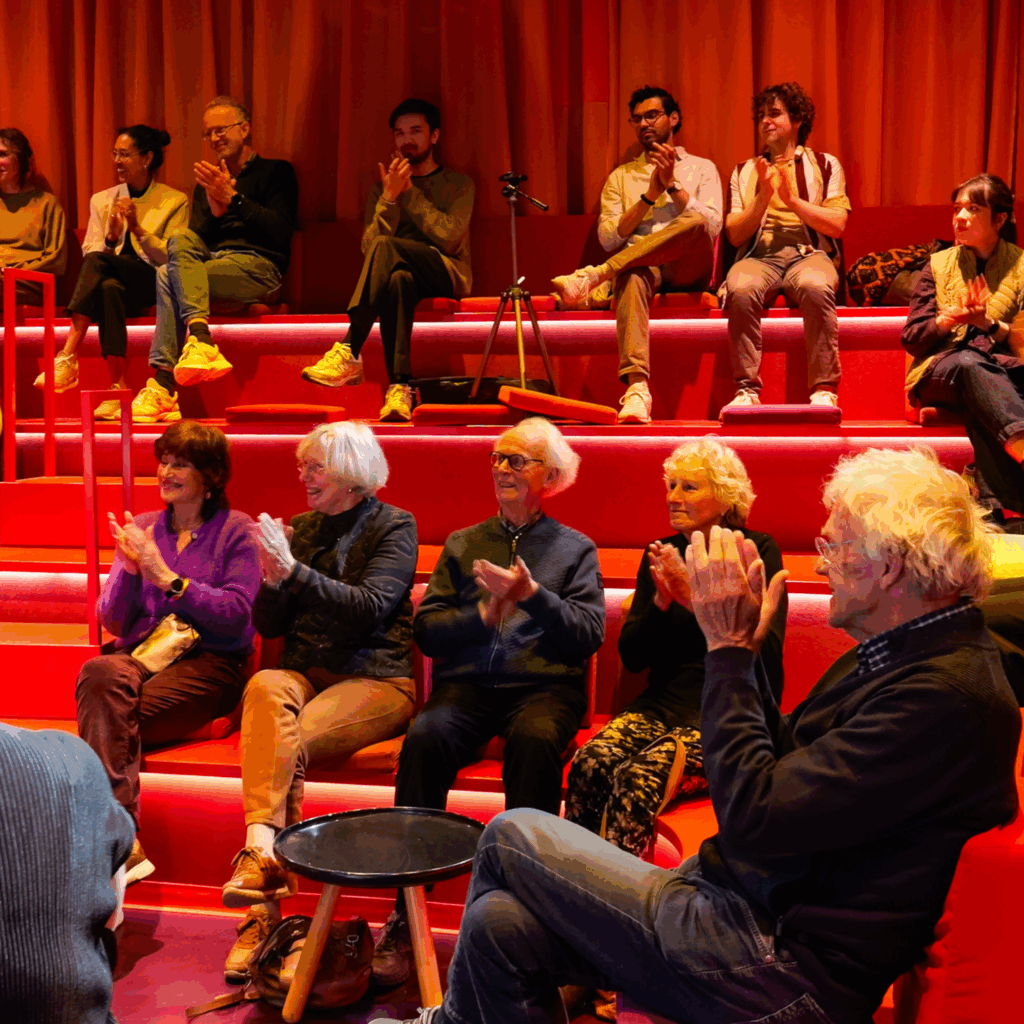
event in de red space met bezoekers

Een goed event begint lang voor de dag zelf. Niet met een moodboard of een thema, maar met een eerlijke vraag: wat moet er eigenlijk gebeuren, en in welke volgorde? De planning is het onzichtbare skelet van elke geslaagde dag. Als die klopt, merkt niemand het. Als die niet klopt, merkt iedereen het.

Hieronder vijf tips die je helpen om structuur te brengen in je voorbereiding. Geschreven vanuit wat wij bij @droog dagelijks zien werken, en wat niet.

tip 1: begin met het einde

De meeste organisatoren beginnen bij het begin. Dat is begrijpelijk, maar het is niet altijd slim. Begin liever bij de vraag: wat moet een deelnemer aan het einde van dit event hebben meegekregen? Een inzicht, een beslissing, een gevoel, een netwerk? Zodra dat helder is, vallen de keuzes daarvoor veel makkelijker op hun plek.

Stel dat het antwoord is: mensen moeten met elkaar in gesprek zijn gegaan over een lastig vraagstuk binnen het bedrijf. Dan weet je al dat je geen podiumsessie van anderhalf uur nodig hebt, maar kleinere gespreksformaten, ruimte voor beweging en een plek waar mensen informeel kunnen doorpraten. Dat vraagt een andere opstelling, een andere ruimte, en een ander programma dan een standaard conferentie.

In de praktijk: schrijf aan het begin van je planning letterlijk op wat het gewenste eindresultaat is. Één zin. Alles wat je daarna plant, toets je aan die zin.

tip 2: kies je ruimte vóórdat je je programma vastlegt
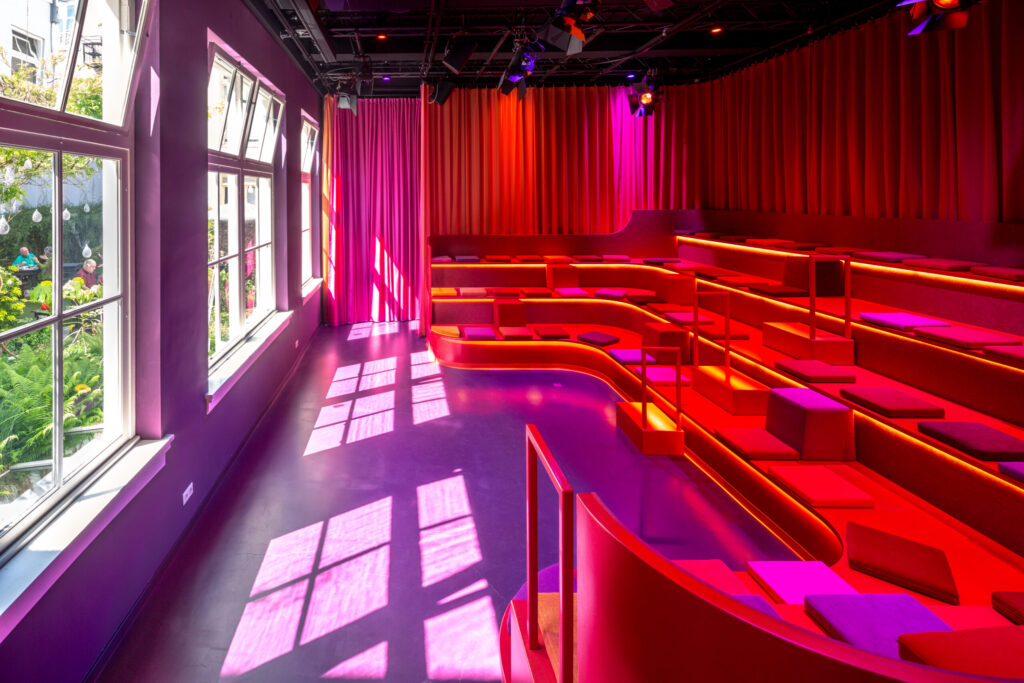
Rode ruimte (The Red Space) met de gordijnen open.

Dit klinkt logistiek, maar het is inhoudelijk. De ruimte bepaalt mede het gedrag van je deelnemers. Een theateropstelling maakt van mensen een publiek. Een ronde tafel maakt van mensen gesprekspartners. Een netwerkborrel in een grote hal maakt van mensen passanten.

Bij @droog hebben we meerdere ruimtes die stuk voor stuk een andere dynamiek meebrengen. The grand space op de begane grond heeft een schuifdeur naar de tuin en past tot 90 mensen zittend of 160 staand. Goed voor plenaire sessies, lezingen, pop-up stores of een borrel aan het einde van een dag. De ruimte heeft een podium en een geluidssysteem.

The red space is ons theatrale hart. Rood, roze, oranje, paars. Een u-vormige tribune met beweegbare kussens voor maximaal 80 mensen, al voelt 50-60 comfortabeler. Minder dan 20 mensen en de ruimte voelt leeg. Dit is de ruimte voor shows, pitches, panelgesprekken of alles wat een theatrale setting vraagt.

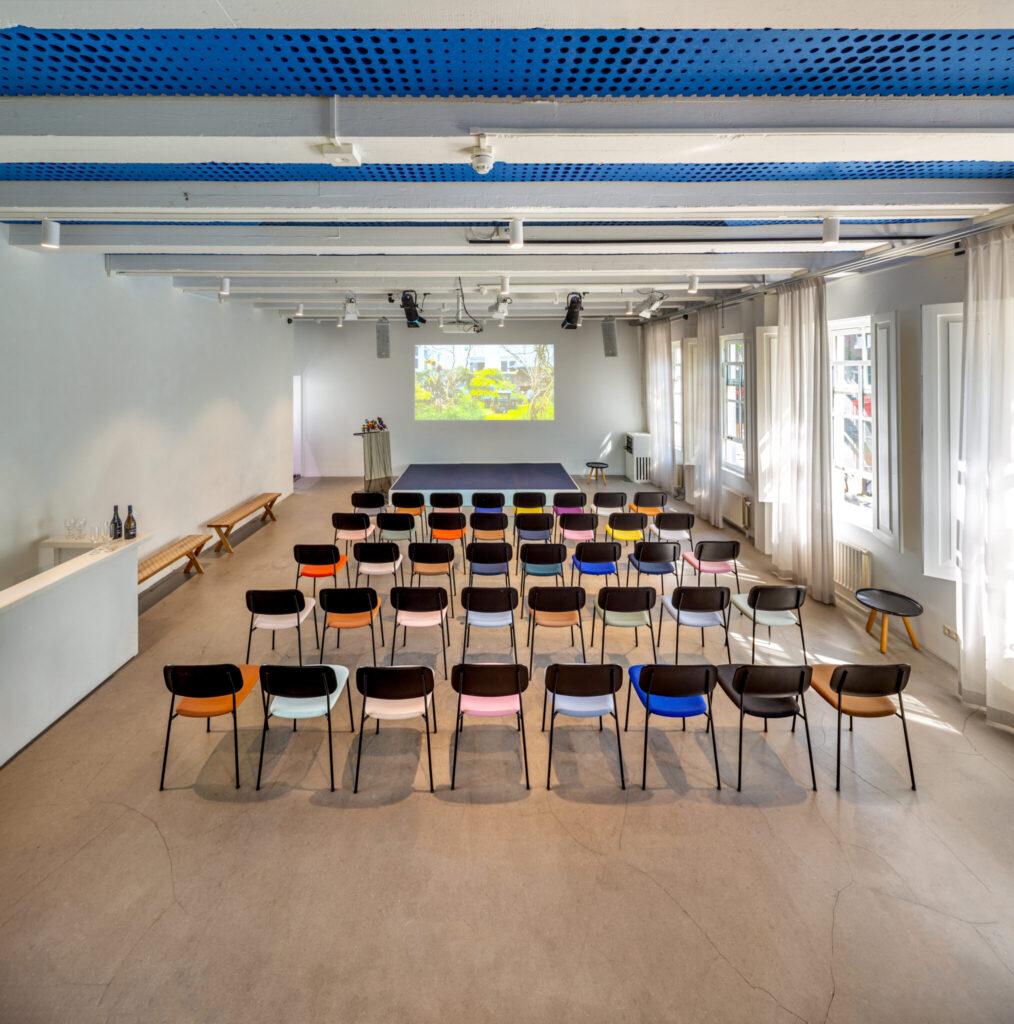
Boven vind je the white space, met grote witte ramen die uitkijken op de Amsterdamse grachtenpanden en de tuin. Tot 70 mensen in theateropstelling, 50 zittend met tafels. Goed voor trainingen, workshops, vergaderingen op grotere schaal, of een boeklancering.

The library is onze meest intieme ruimte. Gele stoelen, een lange tafel, behang gebaseerd op een schilderij uit het Rijksmuseum en een plat luchter plafond. Maximaal 10 mensen aan tafel. Niet meer. Ideaal voor besloten vergaderingen of een privédiner.

En dan is er nog the cafe bovenaan de gele trap. De blauwe vlinderlamp, de bar met witte tegels, het haardvuur. Tot 70 mensen zittend, 180 staand. Misschien wel onze mooiste ruimte, met uitzicht op de Groenburgwal.

De tip: reserveer je ruimte niet op capaciteit alleen, maar op wat de ruimte doet met mensen. En weet dat je bij @droog ruimtes kunt combineren. Breakout-sessies, dinners, trainingen en borrels kunnen tegelijkertijd op verschillende verdiepingen plaatsvinden.

tip 3: bouw buffers in, niet als optie maar als vaste regel

Elk event heeft een tijdlijn. Sprekers, catering, techniek, aankomst. En elk event loopt ergens uit. Dat is geen probleem als je dat had voorzien.

Een buffer is niet hetzelfde als leegte. Het is de ruimte die je deelnemers nodig hebben om een gesprek af te maken, nog even naar het toilet te gaan, of om van de ene ruimte naar de andere te lopen zonder te rennen. Een programma zonder buffers is een programma dat achterloopt vanaf het eerste moment dat iemand te laat aankomt.

Praktische vuistregels:

  • Plan na elke sessie van meer dan 45 minuten minimaal 10-15 minuten vrij.
  • Reken bij catering altijd op 15 minuten extra aanlooptijd. Mensen eten en drinken niet op commando.
  • Plan de eerste buffer in direct na het welkom. De aanloop duurt bijna altijd langer dan gepland.
  • Bouw aan het einde van de dag een zachte landing in, geen harde stop. Mensen die nog willen doorpraten verdienen die ruimte.

Een buffer is ook een signaal aan je deelnemers: we hebben niet elke minuut volgestopt. Er is ruimte om te ademen. Dat gevoel is onderdeel van de ervaring.

tip 4: maak een technisch draaiboek naast je programma

Het programma is voor je deelnemers. Het draaiboek is voor jou en je team. Ze zijn niet hetzelfde.

Een technisch draaiboek bevat alles wat er achter de schermen moet gebeuren om het programma te laten kloppen. Denk aan: wanneer wordt de beamer aangezet, wie ontvangt de catering, welke microfoon gaat naar welke spreker, wie opent de schuifdeur naar de tuin, wanneer wordt de tafel in the library klaargemaakt voor het diner.

Schrijf dit draaiboek in kolommen. Tijdstip, actie, verantwoordelijke. Niet meer dan dat. Hoe helderder het document, hoe minder vragen er op de dag zelf gesteld worden.

Deel het draaiboek van tevoren met iedereen die een rol heeft, inclusief de locatie. Bij @droog werken we graag mee aan het opstellen van zo’n document. Wij kennen de ruimtes, de routes, de logistiek. Een gezamenlijk draaiboek voorkomt miscommunicaties die anders pas op de dag zelf aan het licht komen.

Een goed draaiboek bevat ook een spoedcontact voor elke partij. Techniek loopt soms mis. Een spreker komt toch later. De catering is vertraagd. Als je weet wie je waarvoor belt, lost dat in 90% van de gevallen zichzelf op binnen vijf minuten.

tip 5: evalueer vóórdat je het event vergeet

Dit is de tip die het vaakst wordt overgeslagen, omdat hij aan het einde van een lange dag valt. Maar de evaluatie is het moment waarop je leert wat je bij het volgende event beter kunt doen.

Doe het in twee stappen:

Stap één: de dag zelf, binnen een uur na afloop. Schrijf op wat er niet liep zoals gepland. Niet om schuldigen aan te wijzen, maar om patronen te zien. Was de ruimte te krap voor de groep? Liep de catering uit? Hadden deelnemers moeite om de ruimte te vinden? Dit is verse informatie. Morgen weet je het niet meer zo precies.

Stap twee: een week later, als de emotie wat gezakt is. Bekijk het draaiboek en de planning opnieuw. Waar zaten de structurele knelpunten? Was het programma te vol? Was de ruimtekeuze goed? Hadden deelnemers genoeg tijd voor informele contacten?

Een korte enquête onder deelnemers helpt ook. Drie vragen, niet meer. Wat vond je goed? Wat had beter gekund? Zou je terugkomen? De antwoorden zijn vaak verrassend direct en bruikbaar.

Bij @droog horen wij graag hoe een event is verlopen. Niet uit beleefdheid, maar omdat het ons helpt om de volgende keer nog beter mee te denken.

hoe @droog helpt bij de planning

Een locatie is meer dan vier muren en een beamer. Wij denken mee over de structuur van jouw dag. Welke ruimte past bij welk moment in het programma? Wanneer is de combinatie van twee ruimtes slimmer dan één grote? Wat vraagt jouw publiek aan opstelling, licht, catering en routing?

@droog is in 1993 ontstaan vanuit een designfilosofie die vraagt waarom iets zo gedaan wordt als het altijd zo gedaan wordt. Die vraag stellen wij ook bij events. Niet om het ingewikkelder te maken, maar om het beter te maken.

Duurzaamheid speelt daarin mee. De catering die wij serveren komt zoveel mogelijk van lokale leveranciers. Het gebouw zelf, gebouwd in 1641 als gildehuis, is ingericht met oog voor materiaalgebruik en hergebruik. Wat je ziet, is niet toevallig gekozen.

Zit je nog in de planningsfase en wil je sparren over opzet, ruimtekeuze of programma? Vertel ons wat je in gedachten hebt.

request quote

veelgestelde vragen over eventplanning bij @droog

hoe ver van tevoren moet ik mijn event plannen?

Voor een event met meerdere ruimtes, catering en een volledig programma raden wij aan om minimaal zes tot acht weken van tevoren te beginnen. Voor kleinere meetings in bijvoorbeeld the library is vier weken vaak voldoende. Beschikbaarheid van ruimtes speelt daarin een rol, dus hoe eerder je contact opneemt, hoe beter.

kan ik meerdere ruimtes combineren tijdens één event?

Ja. Dat is juist een van de sterkste kanten van @droog. Je kunt een plenaire sessie in the grand space combineren met breakout-sessies in the white space en the library, en een diner in the cafe. Wij helpen je de logistiek en routing in het draaiboek te verwerken.

hoe groot mag mijn groep zijn?

Dat hangt af van de ruimte. The grand space past 90 mensen zittend of 160 staand. The cafe past 70 zittend of 180 staand. The red space heeft een tribune voor maximaal 80 mensen. The white space past 70 in theatervorm of 50 zittend met tafels. The library is voor maximaal 10 mensen. Bij combinaties van ruimtes kunnen grotere groepen goed worden gefaciliteerd.

wat als mijn programma tussentijds verandert?

Dat gebeurt. Een spreker valt weg, een sessie duurt langer. Zorg altijd voor een contactpersoon op locatie die beslissingen kan nemen. Een goed draaiboek met buffers geeft je de ruimte om bij te sturen zonder dat deelnemers het merken.

bieden jullie ook catering aan?

Ja. Ons cafe restaurant verzorgt catering voor events. We werken met lokale leveranciers en stemmen het aanbod af op het programma en de groepsgrootte. Of het nu gaat om een lunchdienst, borrelplateau of een volledig diner, vertel ons wat je nodig hebt.

is er technische ondersteuning aanwezig?

The grand space, the red space en the white space zijn uitgerust met beamers en geluidsapparatuur. Voor complexere technische opstellingen werken we samen met externe technici. Bespreek dit bij je boeking zodat we alles van tevoren kunnen afstemmen.

wat maakt @droog anders dan andere eventlocaties in Amsterdam?

@droog is geen neutrale huurruimte. Het gebouw heeft een geschiedenis, een designcultuur en een standpunt. Elk detail in het pand is bewust gekozen. Dat merk je als gast. Mensen verlaten een event hier met meer dan alleen een agenda die is afgewerkt. Dat is wat wij nastreven.

tot slot

Een goede eventplanning is geen checklist die je afvinkt. Het is een manier van denken. Begin bij het doel, kies je ruimte bewust, bouw buffers in, maak een technisch draaiboek en evalueer nadat het stof is neergedaald. Die vijf stappen maken het verschil tussen een dag die loopt en een dag die beklijft.

Wil je weten hoe @droog jouw volgende event kan ondersteunen? We denken graag mee.
request quote

10 tips for an event that visitors would have fomo about

10 tips for an event that visitors would have fomo about

Most events are forgotten before the taxi home. People check their phones during the keynote, grab a dry sandwich, and leave without talking to anyone they didn’t already know. That’s not a venue problem. It’s a design problem.

FOMO, the kind that makes people scroll through someone else’s event photos wishing they’d been there, doesn’t happen by accident. It’s built. Deliberately. With decisions that most event planners skip because they feel too small, too weird, or too hard to justify in a budget meeting.

These ten tips are practical. They’re based on what actually works, what guests remember, and what makes them tell someone else about it the next morning.


1. give the event a reason to exist

Not a theme. A reason. There’s a difference.

A theme is “innovation” on a banner above the registration desk. A reason is: we’re bringing 60 people together because we’re genuinely stuck on a question and we think the answer is in this room. One of these creates FOMO. The other creates lanyard waste.

Before anything else, write one sentence that explains why this event needs to happen. Not what it is. Why it exists. If you can’t write that sentence, attendees will feel it. They won’t know why, but they’ll feel it.

At @droog, every event we host starts with a conversation about intent. What shift do you want people to experience by the time they leave? That question shapes everything: the room, the format, the food, the order of the day.


2. choose a space that does some of the work for you

event in de red space met bezoekers

A neutral conference room is neutral on purpose. It’s designed not to distract. But distraction, in the right direction, is exactly what makes an event memorable.

When someone walks into the red space, a fully red-pink-orange-purple theatre with a round u-shaped tribune and cushions built into the architecture, they stop talking. For a second. That pause is valuable. It says: this is different. Something here is worth paying attention to.

Spaces with history, texture, and character reduce the amount of decoration you need and increase the amount of conversation you get. People talk about the room. That’s not superficial. It’s social glue.

The building matters. Pick one that earns its place in the story.


3. design for the first five minutes

Research on event memory is consistent: people remember beginnings and endings far more than the middle. Most event budgets are spent on the middle.

What happens in the first five minutes when someone walks in? Is there something to look at, to touch, to taste, to ask about? Or is there a registration queue and a table of branded pens?

A few things that work: a person who welcomes guests by name, a single object in the centre of the room that sparks a question, a smell from the kitchen that tells people something real is being cooked. Small inputs, strong outputs.

The entrance sets the tone. Set it on purpose.


4. feed people like you mean it

Food is not logistics. It is a statement about how much you value the people in the room.

Shrink-wrapped sandwiches say one thing. A lunch built around seasonal, locally sourced ingredients, served at a table where people are expected to sit down and stay a while, says something else entirely. That difference is felt, even when it’s not named.

At @droog, the kitchen operates with a simple idea: lunch is worth sitting down for. That hasn’t changed since 2004. The café restaurant, with its curved white tiled bar, blue butterfly lamp, and view over the Groenburgwal canal, seats 70 and holds up to 180 standing. It also makes people linger. Lingering is where the real conversations happen.

If your catering could be from any hotel in any city, it’s doing nothing for your event. Make it specific.


5. build in a moment nobody expected

One. You only need one.

It can be a room reveal, an unannounced guest, a question that lands differently than anything else in the program, a shift in format that catches people off guard. The point is that the event did something the attendee didn’t see coming.

That moment is what gets described the next day. “And then they took us into this completely red theatre and…” That sentence, told at someone’s kitchen table or in a Slack channel, is worth more than any post-event email campaign.

Design one unexpected moment. Put it where energy tends to dip, usually mid-afternoon. Let it breathe.


6. make the format match the content

Theatre setting for a talk about breaking hierarchy. Round tables for a conversation about collaboration. Standing for energy. Sitting close for intimacy. These aren’t decorating decisions; they’re communication decisions.

The wrong format undermines the best content. A panel discussion in a room where the panellists are six metres away from the first row of seats creates distance, literally, and psychologically. A 90-minute lecture in a room designed for 30 that’s holding 80 creates frustration before anyone opens their mouth.

The grand space at @droog seats 90 or holds 160 standing, has a stage and a full sound system, and opens directly onto the garden. The white space upstairs fits 70 in theatre setting or 50 at tables, with large windows looking out onto old Amsterdam rooftops. The library seats exactly 10 around a long table under a flat chandelier, flowered wallpaper from a Rijksmuseum painting on the wall. Three completely different formats for three completely different conversations.

Choose the room the way you’d choose the words. Deliberately.


7. give people a reason to talk to strangers

Networking doesn’t happen because you put people in the same room and call it a networking break. It happens when there’s a shared context, a conversation starter, or a structured prompt that removes the awkwardness of the opening line.

Practical things that work: a provocative question on the table, a collaborative activity with a real output, a room layout that physically prevents people from staying in their own cluster. Even something as simple as assigned seating at lunch, mixing teams or companies, produces more cross-pollination than an hour of free-form mingling.

grand space in congres setting

The goal is not more conversations. It’s one conversation that someone didn’t expect to have. That’s the one they remember.


8. use multiple spaces across the day

A single room for eight hours flattens the experience. Movement through different spaces, with different characters, different scales, different atmospheres, creates a sense of journey. The day feels longer in the good sense. More was experienced. More is remembered.

This is one of the structural advantages of a building like @droog. A plenary session in the grand space, a breakout in the library, lunch in the cafe, a show or workshop in the red space, drinks in the garden. Each space hands off to the next. The building does the pacing for you.

Even if you’re working with a simpler layout, think about transitions. A change of room is a change of register. Use it.


9. end with something people carry out

Not a tote bag. Something they carry in their head.

The best event endings leave people mid-sentence. They’re still thinking about something when they get on the train. A question that didn’t get answered. A perspective that shifted. A commitment made in a room full of people who witnessed it.

Practically: end with a provocation, not a summary. End with a question, not a conclusion. End ten minutes earlier than people expect, while the energy is still up. Don’t recap everything that happened. Trust the experience to speak for itself.

The closing moment sets what people take home. Design it with the same care as the opening.


10. document it in a way that creates envy

FOMO requires evidence. If nothing from the event is visible to the people who weren’t there, there is no FOMO. There is just an event that happened.

Documentation doesn’t mean a professional photographer wandering around with a zoom lens. It means capturing the specific, the telling detail: the red tribune full of people, the library table mid-debate, the garden at dusk with glasses still on the tables. The image that makes someone think “I should have been there.”

Make it easy for attendees to share. Give them something worth sharing. A sentence from the day that crystallises what happened. A photograph that shows the room at its best. A short video of the one moment that surprised everyone.

Organic sharing from people who were actually in the room is worth more than any campaign. It’s credible. It’s specific. And it makes next year’s event oversubscribed before the invitations go out.


putting it together: what a fomo-worthy event actually looks like

Here’s a concrete example. Sixty people. One question the organisation is genuinely trying to answer. Morning session in the grand space: talks, a panel, real disagreement on stage. Lunch in the cafe restaurant, seated, local food, mixed tables. Afternoon in the red space: a workshop format with the cushioned tribune reconfigured for groups. Late afternoon: the library for a smaller working session of ten, the rest in the garden. Closing in the white space: one final provocation, ten minutes of silence for people to write something down, then done.

No filler. No slide deck summary at the end. No branded giveaway. The day had a shape. Every room earned its place. People left mid-thought.

That’s the version that gets described at the next dinner party.

request quote


frequently asked questions

what makes an event worth talking about after?

Specificity. People don’t remember “a great conference.” They remember the unexpected moment, the conversation at lunch, the room that looked nothing like a conference room. Build at least one thing that couldn’t have happened anywhere else.

how many people do you need for a good event?

It scales in both directions. Ten people around a long table in the right room, with the right question on it, can be more impactful than 200 in a hotel ballroom. Intimacy and intention matter more than headcount. That said, for larger groups, 60 to 100 tends to be the range where serendipitous connections happen most naturally.

is it better to have one space or multiple spaces?

Multiple spaces, used with purpose. Each transition between rooms resets attention and changes the social dynamic. One room for eight hours creates a single note. Multiple spaces create a progression. The key is that each space should earn its place in the day’s structure, not just exist as an overflow option.

how far in advance should you plan an event?

For an event of 30 to 80 people with a clear program, six to eight weeks is workable if decisions are made quickly. For anything more complex, with multiple spaces, outside speakers, or a custom catering program, three to four months gives room to make it good rather than just functional. The earlier you know the intent and format, the better every other decision becomes.

what role does the venue play in making an event memorable?

A significant one. The venue sets expectations the moment people walk in. A space with character, history, and design reduces the work the program has to do and increases the emotional baseline people arrive with. It also gives attendees something to describe, which is the starting point of every word-of-mouth conversation afterward.

how do you create FOMO without overpromising?

By delivering something specific rather than claiming something general. “An unforgettable experience” is a promise anyone can make. “60 people, one question, five rooms, and a kitchen that takes lunch seriously” is a description. Descriptions create anticipation. Anticipation, when met, creates the kind of satisfaction people share.


An event worth having FOMO about is not more expensive to produce. It’s more intentional. It starts with a reason, picks a space that contributes, designs the moments people remember, and ends before the energy does.

If you’re thinking about what that could look like for your next gathering, tell us what you have in mind.

request quote

5 tips for good planning during my event

5 tips for good planning during your event

Planning an event sounds simple until you’re standing in the middle of it. The catering runs late. The AV setup takes twice as long as expected. Someone forgot to brief the speaker on timing. Good event planning isn’t about having a perfect script. It’s about knowing where things go wrong, before they do.

These five tips come from what we’ve learned at @droog, running B2B events in a building from 1641 that has hosted everything from theatre performances to panel discussions to private dinners for ten. Design thinking is at the core of everything we do here, and that includes how we think about time, space and flow.


tip 1: start with the flow, not the programme

Most event planners start by filling a schedule. What time does the keynote start? When is lunch? That’s the wrong order.

Start with movement. How do people enter? Where do they go first? What does the transition from one part of the event to the next actually look like, physically? A programme on paper doesn’t tell you that the walk from registration to the main room takes four minutes, or that the corridor bottlenecks when 80 people try to move at once.

At @droog, the grand space on the ground floor connects directly to the garden and the red space. That’s not a coincidence. It means that during a break, people naturally spread out without being directed. Flow is designed into the building. For your event, the same principle applies: design the movement before you design the agenda.

A practical method: walk the entire event yourself before the day. Enter through the front door. Move through every space in the order guests will. Note every moment where people might cluster, get confused, or have to wait. Fix those moments, not with instructions, but with layout.

  • Draw a simple floor map with arrows showing guest movement
  • Mark every transition point (registration to welcome, welcome to session, session to break)
  • Add realistic time buffers to each transition, at least five minutes per move for groups over 30
  • Brief your team on flow, not just on tasks

tip 2: match the space to the purpose, not the headcount

Rode ruimte (The Red Space) met de gordijnen open.

The most common planning mistake isn’t picking a space that’s too small. It’s picking a space that fits the number but not the energy.

A room that seats 80 feels very different with 20 people in it. The red space here is a good example of this: its u-shaped tribune seats up to 80, but when fewer than 20 people are sitting on it, the space reads as empty. That changes the energy of whatever you’re trying to do. For a small group, you’d want the theatre feeling of a full room, which means either filling the seats or choosing a different space entirely.

The principle: a space should feel right for the number of people in it, not just accommodate them. Too large and there’s no tension, no focus. Too small and people get restless. The sweet spot is a room where the capacity feels slightly full, where there’s enough proximity that conversation happens naturally but enough room that people don’t feel crowded.

Questions to ask when matching space to purpose:

  • What energy does this session need? Intimate or expansive?
  • Does the layout encourage the behaviour you want (conversation, focus, participation)?
  • Will the room feel full or empty at your actual guest count?
  • Does the space signal the right thing? A boardroom signals formality, a design space signals open thinking

Different sessions often need different spaces. A morning keynote for 90 people, a breakout for 15, a working lunch for 30: those are three different rooms with three different setups. Events don’t have to live in one space.


tip 3: brief every supplier on the same timeline, with the same document

Miscommunication between suppliers is one of the leading causes of event delays. The caterer thinks setup starts at 13:00. The AV team thought it was 12:00. The venue coordinator has 11:30 in her notes. All three are working from separate conversations, separate emails, and separate assumptions.

One document. Every supplier. Updated in real time.

This doesn’t need to be complex. A shared spreadsheet with columns for time, action, responsible party and status is enough. What matters is that every person working on your event is looking at the same source of truth. When something changes, it changes in one place, and everyone sees it.

At @droog, events sometimes run across multiple rooms: a plenary in the grand space, breakouts in the white space, a private dinner in the library, drinks in the cafe. Each of those spaces has its own setup requirements, its own timing, its own team. A single shared runsheet is the only way to keep that from becoming four separate events happening in parallel without coordination.

What your runsheet should include:

  • Load-in and setup times per supplier, per space
  • Sound check and tech rehearsal slots (never skip these)
  • First guest arrival time, with 15 minutes of buffer before it
  • Session start and end times, with hard stops marked clearly
  • Break durations, catering delivery moments, Q&A slots
  • Load-out and cleanup responsibilities
  • Emergency contacts for every key person

Send this document to every supplier no later than five days before the event. Review it together in a 30-minute call. Then don’t touch it, unless something genuinely changes.


tip 4: protect your transitions

Sessions run long. Lunch takes longer than planned. A speaker has three more minutes of material. These things happen at every event. The question isn’t whether transitions will be disrupted. It’s whether you’ve protected them enough to absorb the disruption.

The answer is usually buffer time. Not five minutes between a 60-minute keynote and a 60-minute workshop. Fifteen. Because the keynote ran eight minutes over, the moderator asked two follow-up questions, and 70 people need to walk from one room to another, find their name on a table, and settle in before the next session can start.

There’s a specific kind of transition that planners consistently underestimate: the technical transition. Switching from one presentation to another, resetting a room layout, connecting a new speaker’s laptop to the AV system. Each of these takes time. At minimum, add ten minutes of technical buffer for every major setup change during your event.

A checklist for protecting transitions:

  • Add 10 to 15 minutes between every major session
  • Assign one person as timekeeper, with authority to interrupt speakers when time is up
  • Pre-load all presentations on one device, not each speaker’s own laptop
  • Test every AV switch during the tech rehearsal, not on the day
  • Have a contingency plan for the session that will definitely run long

Good transitions are invisible. Nobody notices them. Bad transitions are memorable for all the wrong reasons.


tip 5: design the end as carefully as the beginning

Most events are planned from the front. Registration is detailed, the opening is rehearsed, the first hour is tight. Then somewhere around the midpoint, the plan gets vaguer. By the time you reach the closing session, you’re improvising.

The end of your event is what people remember. Not because memory works that way by accident, but because endings carry emotional weight. A strong close, a clear moment of completion, a last impression that lands well: these are what guests take home. A weak ending, an event that just stops rather than concludes, leaves people with a vague sense of incompleteness.

Design the last 30 minutes as carefully as you designed the first 30. This includes:

  • A defined closing moment, not just the last session ending
  • A clear signal that the formal programme is done
  • Something for people to take with them, literally or conceptually
  • A plan for what happens next: drinks, departure, networking
  • A thank you that names the people who made it happen

At @droog, we’ve seen events close with a drink in the garden, a shared meal in the cafe, and a final round of discussion that moved from the grand space to the library as numbers dwindled. None of those were accidents. They were planned.

One more thing: brief your team on the close as specifically as you brief them on the open. Who dims the lights? Who signals catering to start clearing? Who stands at the door to say goodbye? Small details, but they’re the ones guests remember.


Good planning doesn’t mean controlling everything. It means deciding in advance what matters, building structure around it, and leaving room for the things you can’t predict. The rest takes care of itself.

If you’re planning a B2B event and want to talk through the setup, we’re happy to think it through with you.

request quote


frequently asked questions

how far in advance should I start planning my event?

For a B2B event with 50 or more guests, start at least eight to twelve weeks out. That gives you time to confirm the venue, brief suppliers, finalise the programme and still have three weeks of buffer before the day for last-minute changes. Smaller events, 20 people or fewer, can be planned in four to six weeks if the programme is straightforward.

how do I plan an event across multiple rooms?

Start with a single master runsheet that covers all rooms simultaneously. Map out what’s happening in each space at every point during the day. Identify moments where guests move between spaces and assign a coordinator to each transition. Events at @droog often use the grand space, white space, library and cafe in sequence across a single day. The key is one document, not four.

what is the biggest planning mistake event organisers make?

Underestimating transitions. Not the sessions themselves, but the time between them. Technical setup, room changes, guest movement, AV switches: these eat into your programme faster than almost anything else. Build in more buffer than you think you need, then protect it.

how do I choose the right room setup for my event?

Match the layout to the energy you need. Theatre-style for focus and presentation, round-table for discussion and participation, standing for networking and energy. Then check whether your actual guest count fills the room or leaves it feeling empty. A room that seats 80 with 15 people in it has a very different atmosphere than a room built for 20 with 18 people in it.

what should I include in a supplier briefing document?

Setup times, access instructions, technical requirements, the runsheet, contact details for the venue coordinator, and a clear point of contact for the day. Send it at least five days before the event and follow up with a short call. One document, shared with everyone, updated in one place.

can I use multiple spaces at @droog for a single event?

event in de red space met bezoekers

Yes. Events here regularly combine rooms depending on programme needs: plenary sessions in the grand space, breakouts in the white space, a private working lunch in the library, closing drinks in the cafe or garden. We’ll help you think through which combination makes sense for your programme.


Planning well is mostly a matter of asking the right questions early. Flow before programme. Space before capacity. One document before many conversations. A strong close, not just a strong start.

Tell us what you have in mind.

request quote

10 tips voor een evenement waar bezoekers FOMO voor zouden hebben

10 tips voor een evenement waar bezoekers FOMO voor zouden hebben

Je hebt een evenement gepland. De datum staat. De catering is geregeld. En toch blijft die ene vraag hangen: gaan mensen er écht voor komen? Niet uit plicht, maar omdat ze het gevoel hebben dat ze iets missen als ze wegblijven?

FOMO, fear of missing out, is geen marketingtruc. Het is een reactie op iets wat mensen zien en denken: dat wil ik ook hebben meegemaakt. Hieronder tien concrete tips om dat gevoel te creëren, van de eerste uitnodiging tot het laatste moment op het podium.

1. kies een locatie die zichzelf vertelt

De locatie is het eerste wat mensen zien. Niet de agenda, niet de sprekers, maar het beeld. Een conferentiezaal in een business hotel vertelt niets. Een ruimte met een verhaal vertelt alles.

@droog is gevestigd in een pand uit 1641 dat ooit het Lakengildehuys huisvestte, de gilde van de lakenkopers in Amsterdam. Dat detail hoef je niet eens uit te leggen. Het staat in de muren, in de trap, in de verdiepingen die je door moet om bij de juiste ruimte te komen. Mensen onthouden een locatie met een verhaal. Ze vertellen het door aan degenen die er niet bij waren.

Concreet: kies een plek die bezoekers iets te vertellen geeft als ze thuiskomen.

2. maak de route naar het event onderdeel van het event

event in de red space met bezoekers

Bij @droog begin je niet in de zaal. Je begint in de gallery op de begane grond, loopt langs het werk van ontwerpers als Tejo Remy of Maarten Baas, stijgt op via een gele trap en arriveert ergens anders dan je begon. Dat is geen toeval.

Een event met FOMO-waarde begint bij binnenkomst. Denk na over wat iemand ziet, hoort en ruikt voordat de officiële agenda start. Een geur, een object, een onverwachte keuze in de routing zorgt ervoor dat het event al begint bij de deur.

3. noem de mensen, niet alleen het thema

“Kom naar ons event over innovatie” trekt niemand. “Kom luisteren naar Marieke Eyskoot over circulair ontwerpen, gevolgd door een gesprek met de designteams van Interface en Fairphone” trekt mensen die dat willen meemaken, en mensen die spijt krijgen als ze er niet bij zijn.

Namen maken het concreet. Namen zijn controleerbaar. Namen geven credit aan de mensen die er zijn, en geven anderen een reden om te komen of te wensen dat ze waren gekomen.

Benoem elke spreker, elke workshop-facilitator, elke chef die kookt bij het diner. Niet als decoratie, maar als bewijs.

4. bouw één moment dat je nergens anders meemaakt

Dit is de kern van FOMO. Niet het programma als geheel, maar dat ene moment waarvan mensen later zeggen: daar was ik bij.

Dat kan van alles zijn. Een performance in the red space, de theaterzaal van @droog met een U-vormige tribune in rood, roze en paars, waar tot 80 mensen schouder aan schouder zitten en het podium letterlijk om hen heen is gebouwd. Of een besloten diner in the library, met tien mensen om een lange tafel onder een plat luchter, behangpapier gebaseerd op een schilderij uit het Rijksmuseum, en een gesprek dat je elders niet had gehad.

Vraag jezelf dit: wat is het ene moment in mijn programma dat mensen, als ze het horen, denken: had ik er maar bij gezeten?

5. limiteer, maar leg het uit

Schaarste werkt, maar alleen als mensen begrijpen waarom iets schaars is. “Nog 10 plekken beschikbaar” zegt niets. “De library heeft ruimte voor precies tien mensen, en daar stoppen we ook” zegt alles.

Bij @droog is de library niet groot genoeg voor meer dan tien mensen om de tafel. Dat is geen beperking, dat is het punt. Een kleinere groep, een intenser gesprek, een setting die een bordsessie in een hotelzaal nooit kan bieden. Communiceer de reden achter de limiet, dan voelt de exclusiviteit als kwaliteit in plaats van marketing.

6. geef mensen iets om te laten zien

FOMO bestaat bij de gratie van het beeld. Als niemand iets laat zien, is er niets om jaloers op te zijn.

Dat betekent niet: zet een fotograaf in en hoop op het beste. Het betekent: bedenk welke momenten visueel sterk zijn en zorg dat die momenten plaatsvinden op plekken die dat ondersteunen.

The grand space heeft een podium, een schuifdeur richting de tuin en ruimte voor 160 staande bezoekers. Een spreker voor een volle zaal, licht op het podium, een tuin op de achtergrond: dat is een beeld. The cafe bovenaan de gele trap heeft een blauwe vlinderlamp, een open keuken achter een witte gebogen bar en uitzicht op de Groenburgwal. Dat is ook een beeld. Gebruik ruimtes die zich laten fotograferen, want die fotou2019s leven langer dan het event zelf.

7. zet de verwachting neer en draai hem om

De sterkste FOMO-momenten zijn onverwacht. Mensen verwachten een lezing en krijgen een debat. Ze verwachten een lunch en eten aan een tafel met iemand die ze anders nooit hadden ontmoet. Ze verwachten een borrel en lopen een performance in.

Maak één programmaonderdeel dat de verwachting kantelt. Noem het niet van tevoren. Laat het plaatsvinden.

Dit is ook wat @droog als locatie doet. Het gebouw ziet er van buiten niet uit als een evenementenlocatie. Dat is met opzet. De verrassing begint zodra je binnenstapt.

8. voeg de menselijke laag toe aan de catering

Eten is sociaal. Eten is ook politiek, als je het wilt. Lokaal, seizoensgebonden, van een specifieke producent, bereid door een chef met een naam en een achtergrond. Dat zijn details die mensen onthouden en doorgeven.

Bij @droog staat duurzaamheid en lokale inkoop centraal. Dat geldt ook voor wat op tafel komt. Als iemand vraagt waar de wijn vandaan komt en er een antwoord is, is dat een gesprek. Als iemand vraagt waar de wijn vandaan komt en het antwoord is “van de cateraar”, stopt het gesprek.

Geef de catering een verhaal. Eén verhaal is genoeg.

9. denk in ruimtes, niet in één ruimte

Rode ruimte (The Red Space) met de gordijnen open.

Een event dat zich afspeelt op meerdere plekken is inherent interessanter dan een event in één zaal. Mensen bewegen, ze ontmoeten iemand anders in de gang, ze ontdekken een ruimte die ze niet verwachtten.

@droog heeft vijf verschillende ruimtes die elk een eigen sfeer hebben en elk iets anders kunnen. The white space heeft grote witte ramen met uitzicht op de Amsterdamse grachtenpanden en de tuin, past tot 70 mensen in theatervorm en is de ideale ruimte voor een training, een boeklancering of een plenaire sessie. De tuin verbindt de grand space met the red space. The cafe staat bovenaan de trap. De library is aan het einde van de gang.

Verdeel je programma. Laat mensen reizen door het gebouw. Elke verplaatsing is een nieuw gesprek.

request quote

10. sluit af op het moment dat mensen er klaar voor zijn

FOMO na afloop ontstaat niet als een event te lang duurt. Het ontstaat als een event eindigt op het goede moment, net iets eerder dan mensen verwachten. Ze willen nog even blijven. Ze kunnen niet. Ze onthouden dat gevoel.

Plan je afsluiting bewust. Eindig op een herinnering, een quote, een beeld, een zin die mensen meenemen. Niet met de logistieke mededelingen, niet met de bedanklijst. Met iets wat blijft hangen.

De beste event-endings zijn kort. Ze zeggen één ding. En dan is het voorbij.

waarom locatie en design het verschil maken

De tips hierboven zijn allemaal uitvoerbaar, in elke ruimte. Maar de ruimte zelf doet mee. Een locatie die alleen functioneel is, vraagt meer van de organisator. Een locatie die al een verhaal heeft, draagt bij aan elk moment op het programma.

@droog is geen neutrale canvas. Het is een pand uit 1641, gevuld met design van ontwerpers als Jurgen Bey, Hella Jongerius en Tejo Remy, met een filosofie die vraagt: waarom doe je dit, en wat wil je dat mensen meenemen? Die vraag stelt een goede locatie altijd aan zijn gebruikers.

Een event met FOMO-waarde geeft antwoord op die vraag. Niet in de uitnodiging, maar in de ervaring zelf.

veelgestelde vragen over het organiseren van een onvergetelijk event

hoe groot moet mijn event zijn om FOMO te creëren?

Grootte heeft er weinig mee te maken. Een besloten diner met tien mensen kan meer FOMO genereren dan een conferentie met vijfhonderd deelnemers, als het verhaal klopt. Schaarste plus kwaliteit is sterker dan volume.

moet ik social media inzetten tijdens het event?

Niet per se. Live-updates kunnen helpen, maar ze kunnen ook afleiden. Wat wél werkt: zorg dat er op het event momenten zijn die mensen zelf willen delen. Niet omdat je het vraagt, maar omdat ze het willen laten zien. Een beeld uit de red space, een gerecht met een naam, een quote van een spreker. Als die momenten er zijn, komen de posts vanzelf.

hoe combineer ik meerdere ruimtes zonder dat het chaotisch wordt?

Met een duidelijke routing en een programma dat die routing ondersteunt. Plenair in de grand space, breakout in the white space of the library, borrel in de tuin of the cafe. Elke overgang is een moment van beweging en contact. Dat is geen chaos, dat is structuur met ruimte erin.

wat is het verschil tussen een thematisch event en een event met een verhaal?

Een thema is een kapstok. Een verhaal heeft een begin, een midden en een einde. Het beste events bouwen naar iets toe: een inzicht, een beslissing, een moment van herkenning. Denk bij de opbouw niet in blokken maar in spanning: wat weten mensen als ze binnenkomen, wat weten ze als ze weggaan?

hoe ver van tevoren moet ik een event als dit plannen?

Voor een event met meerdere ruimtes, externe sprekers en een specifieke catering: minimaal acht tot twaalf weken. Bij @droog helpen we graag meedenken over de opzet. Beschikbaarheid, programma, catering en techniek zijn allemaal bespreekbaar. Dat begint met een gesprek over wat je wilt dat mensen meenemen.

tot slot

Een event waar mensen FOMO voor hebben is geen kwestie van budget of omvang. Het is een kwestie van keuzes. Welke ruimte, welke mensen, welk moment, welk detail. De locatie helpt, de mensen maken het, het programma geeft richting. En de herinnering is wat overblijft.

Ben je benieuwd wat @droog voor jouw event kan betekenen? Vertel ons wat je in gedachten hebt.

request quote