

checklist for organizing a pop up brand event in a city center for the first time
checklist for organizing a pop-up brand event in a city center for the first time
You have a brand. You have something to say. And now you want to say it in person, in a city, in a space that people will actually remember. Good instinct. Pop-up brand events work because they are physical, temporary, and specific. They demand a decision from the people who show up: I chose to be here.
But organizing one for the first time is a different story. There are logistics nobody warns you about, communication choices that determine who actually shows up, and venue decisions that shape everything downstream. This checklist covers all of it, in the order it tends to matter.
step one: define what kind of event you are actually running
Before you book anything, name the type. These are not the same event and they should not be treated as such.
- Product launch. You are revealing something. The space should do what the product does, or deliberately contrast it. The experience is the first impression.
- Brand activation. You are creating a moment of contact between your brand and a new audience. It is participatory. People do something, not just watch.
- Community event. You are giving something back to the people who already know and support your brand. The tone is generous, not promotional. This is a thank-you, not a pitch.
- Press or trade event. Journalists, buyers, partners. Smaller, more controlled, more information-dense. Different catering, different run of show.
- Hybrid or live-stream event. You are playing to two audiences at once: the room and the feed. That changes your production setup entirely.
Most first-time organizers try to run all five at once. Pick one as the core. Everything else is secondary.
step two: set your numbers before you set your budget
How many people are you expecting? Be honest. Fifty people in a room built for two hundred looks like a failure even if the event was excellent. Twenty people in a room built for twenty-five feels full.
Decide on a realistic attendance target, then work backwards. That number determines your venue size, your catering quantities, your production complexity, and your communication volume. Without it, every other decision is guesswork.
step three: choose the right venue for the right reasons
In a city center, you are competing with everything around you for attention. The venue is part of your brand statement on the day. It should do some of the work for you.
Ask these questions before you sign anything:
- Does the space fit your audience size, not just technically but experientially?
- Can you brand or dress the space, or is it already so designed that it resists overlay?
- Is there a separate area for catering, registration, or breakout conversation?
- Is there natural light? Outdoor access? A garden?
- Is the AV built in, or do you bring your own?
- What is the load-in and load-out policy? Do you have the building the night before?
- Is the location walkable from public transport? In a city center, this matters more than parking.
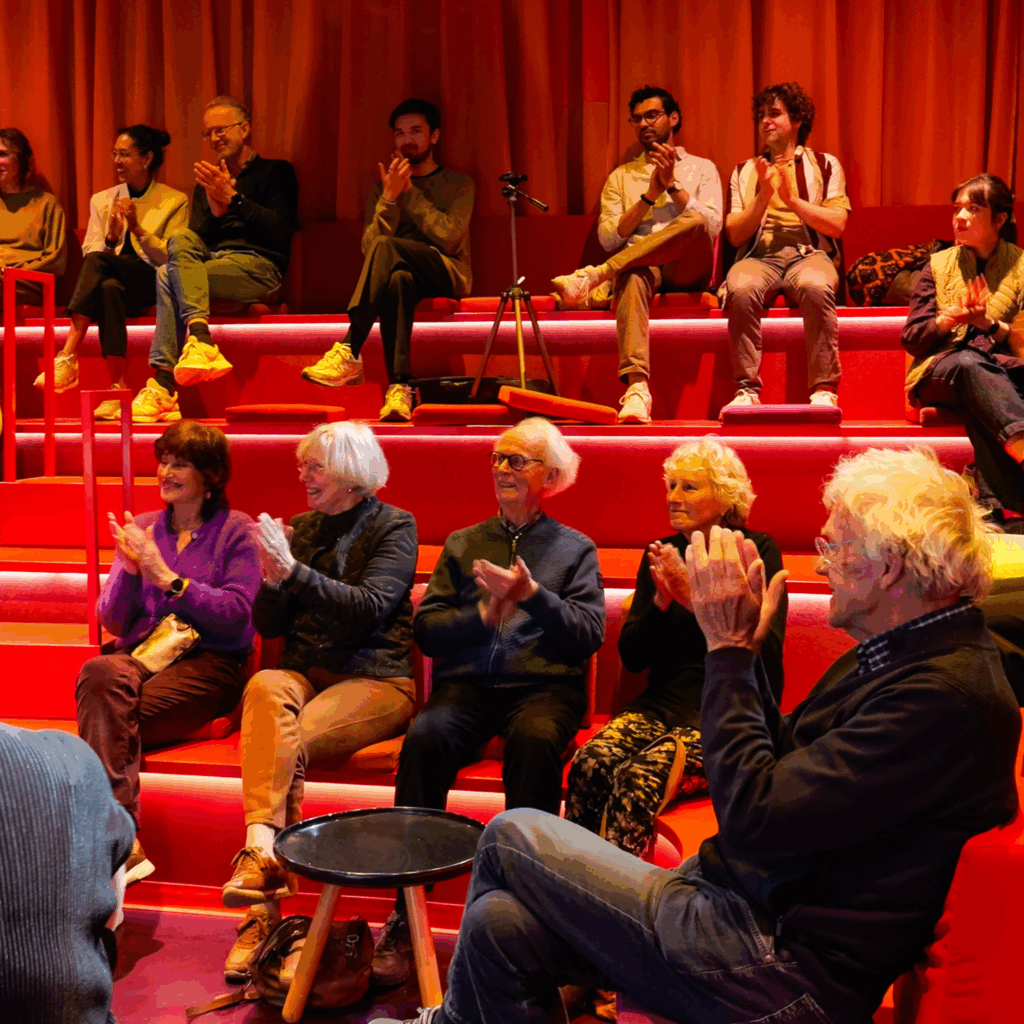
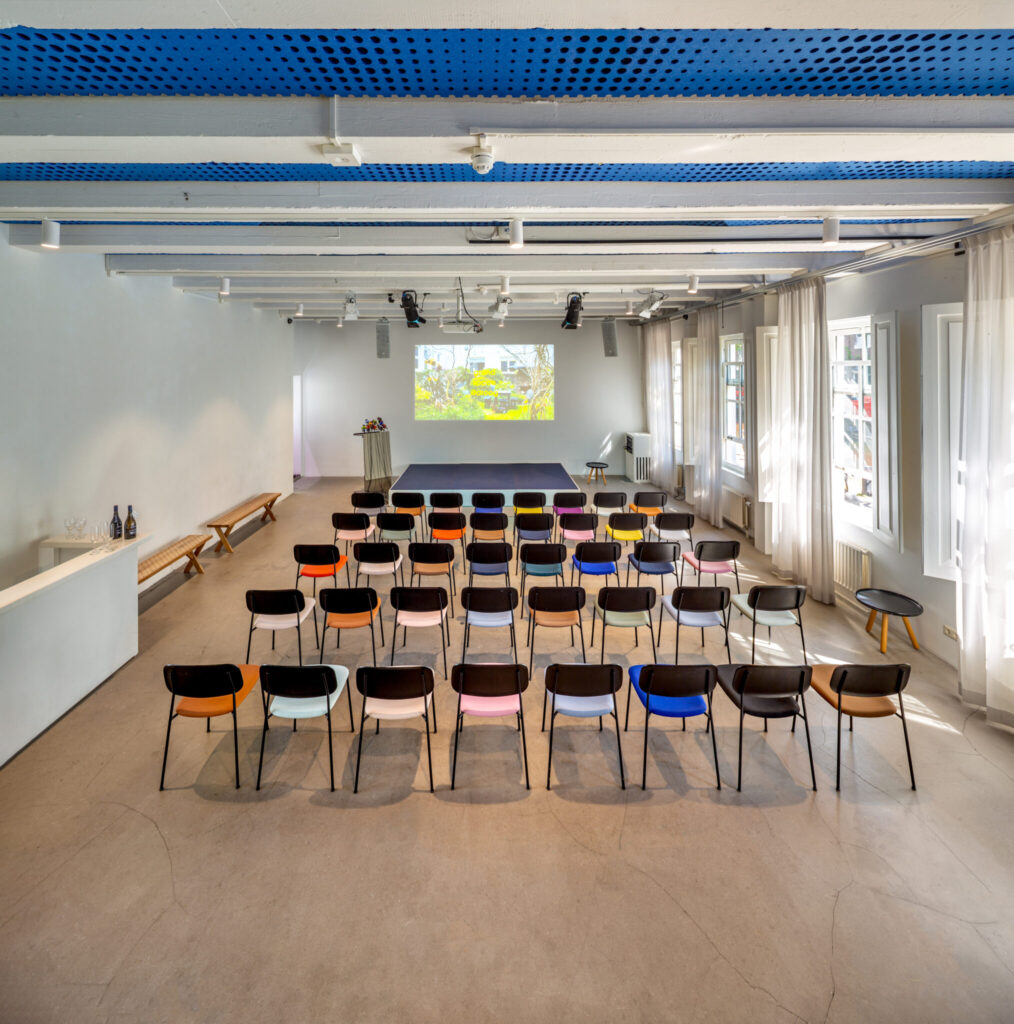
At @droog, the building from 1641 on the Groenburgwal in Amsterdam already carries a point of view. The grand space seats 90 or holds 160 standing, with a stage, a sound system, and a beamer. It opens directly to the garden. It has held pop-up stores for Charlotte Tilbury, Shiseido, and others. Next to it is the red space, a full theatre in deep reds, oranges and purples, with a u-shaped tribune for up to 80 people. Upstairs, the white space handles up to 70 in theatre setting or 50 with tables. The library seats 10 around a long table with yellow chairs and a Rijksmuseum-inspired wallpaper for the kind of meeting that should not feel like a meeting. And the cafe at the top of the yellow staircase fits 180 standing or 70 seated, with a view of the canal.
Events here are not limited to one room. If you need a plenary, a breakout, a dinner, and a drinks reception, you use the building. That is what it is for.
step four: build your run of show
A run of show is not a schedule. A schedule says what happens when. A run of show says who does what, where they stand, what they say, what plays behind them, and who is responsible if it goes wrong.
Build it in a shared document. Include:
- Load-in start time and who oversees it
- AV check and who signs off
- Guest arrival window and who is on the door
- Each segment with duration, speaker name, and tech cue
- Catering timing (pre-event, mid-event, closing)
- Load-out end time and who is last to leave
Add fifteen minutes of buffer after every major transition. First-time organizers underestimate how long it takes for people to move from one room to another, find their seats, or stop talking at the bar.
step five: logistics that people forget until it is too late
These are the things that cause problems on the day:
- Registration and check-in. Who manages the guest list at the door? Is there a system, or a printed sheet? For events over 50 people, a printed sheet is not enough.
- Badges or no badges. For community and press events, yes. For brand activations and consumer pop-ups, usually no. It depends on the tone.
- Coat check. In a city, in winter, 80 people will arrive with coats. Where do they go?
- Catering quantities. Rule of thumb: plan for 80% attendance of confirmed RSVPs. People cancel. Order slightly more food than you think you need. Order less alcohol than you think you need.
- Photography and video. Brief the photographer before the event, not on the day. Send them the run of show. Tell them the three shots that matter most.
- Permits. Some city-center venues require a permit for music above a certain decibel level, or for outdoor use of the garden. Ask the venue. Do not assume.
- Accessibility. Is the venue step-free? Do you have a ramp, elevator access, or accessible bathrooms? This should be in your event description, not discovered on arrival.
And one more: have a point of contact who is not you. You cannot run the event and troubleshoot at the same time.
step six: how to communicate your event, depending on what it is
This is where most first-time organizers either over-communicate or go silent. Neither works.
for a product launch
Build anticipation before the date. Tease the product without revealing it. Send a save-the-date three to four weeks out. Follow up with an invitation two weeks before. Send a reminder 48 hours ahead. After the event, publish a recap quickly, within 48 hours, while the conversation is still happening.
Channels: email to your existing list, targeted social media posts, press outreach if relevant. If the product is visual, invest in pre-event content that shows the space without showing the product.
for a brand activation
You are often trying to reach people who do not yet know you. That means paid amplification, local partnerships, or street-level promotion near the venue. The city center helps here: foot traffic is real. Consider a simple window installation or signage that draws people in without requiring prior registration.
Keep the communication low-friction. No long registration forms. A simple landing page with date, location, and what to expect is enough.
for a community event
Tone matters most here. This is not a campaign. It is a letter to people who already trust you. Write it like one. Personal, direct, specific. Tell them what you have prepared for them. Tell them why now. If your community is small enough, consider individual outreach rather than a broadcast email.
Give them enough time to plan, three weeks minimum, but do not over-remind. One invitation, one reminder, one final details email. That is enough.
for a press or trade event
Journalists are overbooked. Buyers are schedule-driven. Lead time should be four to six weeks minimum, often longer. Send a press release or formal invitation with a clear news hook. Follow up personally by phone or direct message. Confirm attendance one week before. Have a media kit or product information ready at the venue.
for a hybrid or live-stream event
Treat the online audience as a first-class audience, not an afterthought. Brief your speakers on camera presence. Test the stream setup the day before, not an hour before. Have a moderator for the online chat who is physically present in the venue. Send a recap link to online attendees within 24 hours.
step seven: on-the-day communication
Send a final details email the morning of, or the evening before for morning events. Include:
- Exact address with a pin or map link
- What entrance to use (city-center buildings often have multiple)
- Arrival time versus event start time
- What to expect when they walk in
- A contact number for the day itself
Keep this email short. People read it on their phone on the way there.
step eight: after the event
The event does not end when people leave. What you do in the 48 hours afterwards determines how much it compounds.
- Send a thank-you email to attendees. Not a survey with seventeen questions. A short, genuine note with one thing you want them to remember.
- Publish your photo or video content while the event is still in public memory.
- Follow up with specific people you met. Not a mass message, individual ones.
- Document what worked and what did not. Write it down before you forget. Your future self will thank you.
the full checklist at a glance
Use this to work through your planning from start to finish.
before you book anything
- Define the event type: launch, activation, community, press, hybrid
- Set an attendance target
- Set a total budget with a ten percent contingency
- Confirm your date against competing events in the city
venue
- Venue size matches your attendance target
- AV equipment confirmed: beamer, microphone, sound system
- Load-in and load-out times agreed in writing
- Catering facilities or external catering permitted
- Accessibility confirmed and communicated to guests
- Permits identified and applied for if needed
logistics
- Run of show document built and shared with all responsible parties
- Registration or guest list system in place
- Coat check solution confirmed
- Catering quantities ordered
- Photographer briefed with run of show
- Day-of contact person named, not the lead organizer
communication
- Save-the-date sent three to four weeks out
- Invitation sent two weeks out
- Reminder sent 48 hours before
- Final details email sent morning of event
- Post-event thank-you sent within 48 hours
- Photo or video content published within 48 hours
frequently asked questions
how far in advance should I book a venue for a city-center pop-up?
For a weekend date, six to eight weeks minimum. For a weekday, four to six weeks is usually workable. Good venues in city centers book out fast, especially for Thursdays and Fridays. If you have a specific date in mind, make venue confirmation your first action, not your fifth.
how do I know if my venue is too big or too small?
Too small is a solvable problem: you manage the guest list. Too big is harder. A room that is half-full reads as unsuccessful even if everything else went well. If you are uncertain, choose the smaller option and use a waitlist. Demand is a signal worth creating.
do I need a production company for a first event?
It depends on scale and complexity. For events under 50 people with basic AV, a venue with built-in equipment and one technical contact is usually enough. For 100-plus people, a live stream, or a programme with multiple speakers and transitions, a production partner is worth the cost.
how do I get press to actually attend?
Give them a reason that is not your brand. The story has to be interesting on its own terms. A product launch in an unusual space with a specific angle is more interesting than a product launch. Send a personal note, not a mass press release. Follow up once, by phone or voice message. Make attendance easy and arrival time flexible within a window.
how do I build community events that people want to come back to?
Be specific about who it is for. A community event for everyone is a community event for no one. Make it feel like it was made for the people in the room. That means knowing who they are before the event, programming content they actually care about, and making space for them to connect with each other, not just with your brand.
what should I not do at my first pop-up event?
Do not over-programme. First-time organizers fill every minute because silence feels like failure. It is not. People need time to look around, talk to each other, and absorb what they are experiencing. Leave gaps. Trust the room.
one last thought
The best pop-up brand events feel inevitable in retrospect. The space, the guest list, the content, the timing, all of it seems like it could not have been any other way. That feeling is built in advance, in a document nobody sees, by someone who thought through every question before the guests arrived.
Start with this checklist. Adjust it to your brand, your audience, and your budget. Then tell us what you have in mind.