

is amsterdam the right city for my event?
is amsterdam the right city for my event?
Short answer: probably yes. But that depends on what you actually need from a city, not just a postcard version of one. Amsterdam has canals, history and a certain creative reputation that travels well. It also has a compact city centre, good international connections and a concentration of design, culture and innovation that makes it a logical meeting point for people who care about more than just a room with chairs.
This article walks through what Amsterdam can and cannot do for your event, what to look for in a venue, and why the building your meeting happens in changes the meeting itself.
what makes a city good for events?
Before you settle on Amsterdam, it helps to be clear about what you are actually optimising for. Most event organisers think about logistics first: flights, hotels, travel time. That is sensible. But it is only half the picture.
The city and venue you choose send a signal to your attendees before the first slide goes up. A city known for design and creative thinking attracts a different kind of attention than a convention centre in an airport district. That signal is not decoration. It is part of the programme.
Here is what actually matters when choosing a city for a B2B event:
- International accessibility: how easy is it to get there from your key attendee cities?
- Concentration of relevant industries: is the creative, tech or design ecosystem you want to tap into actually present?
- Venue quality and variety: can you find a space that fits your event rather than forcing your event to fit the space?
- Cultural context: does the city support the narrative you want your event to tell?
- Cost and value: what do you get for what you spend?
Amsterdam scores well on all of these. It consistently ranks as one of Europe’s top cities for international business events, with Schiphol airport connecting to over 300 destinations and a city centre you can cross in twenty minutes by bike or tram.
the case for amsterdam
Amsterdam is not a neutral choice. It is a city with a point of view. The Netherlands has a long history of design, trade and pragmatism, and that combination shows up in how the city works, how its creative industry thinks and how people behave in meetings here.
A few things that make Amsterdam stand out as an event city:
Compact geography. The city centre is walkable. Your speakers, delegates and dinner guests do not lose an hour each way in transit. That matters for full-day and multi-day programmes where energy is everything.
International fluency. English is effectively a working language across Amsterdam’s professional and hospitality sectors. Logistics are smoother, communication with suppliers is faster and your international attendees arrive in a city that already speaks their language.
A creative and design ecosystem. Amsterdam is home to the Dutch Design Week satellite community, the Rijksmuseum, Stedelijk Museum, a dense network of studios and agencies and a long tradition of design culture. If your event touches on innovation, sustainability, communication or creative problem-solving, the city itself becomes part of the context.
Variety of venue types. From converted canal houses to contemporary galleries to design-led event spaces, Amsterdam has an unusual concentration of venues with character. You do not have to settle for a hotel ballroom with a black curtain backdrop.
what amsterdam cannot do
It is worth being honest here. Amsterdam is not the right city for every event.
If you need to host 2,000 people under one roof with exhibition space, loading docks and a motorway nearby, Amsterdam is not your best option. The RAI convention centre handles large-scale congresses, but the heart of the city works better for smaller, high-quality gatherings where depth of experience matters more than scale.
Hotel availability in the city centre is also limited relative to some other European capitals. If your group needs 200 hotel rooms within walking distance of your venue, you may need to plan further in advance than you expect. Booking 6 to 12 months out is not unusual for peak periods.
And if your event depends on massive catering operations with industrial kitchen requirements, some of Amsterdam’s most interesting venues simply are not built for that volume. Know your priorities before you fall in love with a space.
the building changes the meeting
This is the part that most event briefs underestimate. Where you hold a meeting changes what happens in the meeting. A room with one door, no daylight and a branded pull-up banner at the front produces a certain kind of thinking. A room with 400 years of history, a designer’s furniture and a garden outside the window produces something else.
@droog sits in a building from 1641 on the Staalstraat in Amsterdam’s city centre. It used to house the Drapers’ Guild. Since 1993 it has been a home for design culture, and the building itself reflects that: nothing inside is accidental.
The space was conceived around Droog Design principles, which means every object, surface and room arrangement has been chosen with deliberate reasoning. Guests who arrive for a product launch or a leadership offsite do not walk into a generic event shell. They walk into an argument about how things should be made and why.
That is what @droog is for. Not to be impressive. To change the frame before the programme begins.
the spaces at @droog
Five rooms, all different. All on one site. You can use them individually or combine them for a full-day or multi-day programme with breakouts, dinners, plenaries and everything in between.
the grand space. Ground floor, sliding door to the garden, stage at the front. Seats 90 or stands 160. This is where conferences happen, panel discussions happen, networking drinks happen. Equipped with beamer and sound system. Large enough for a pop-up store, which Charlotte Tilbury and Shiseido have both done here.
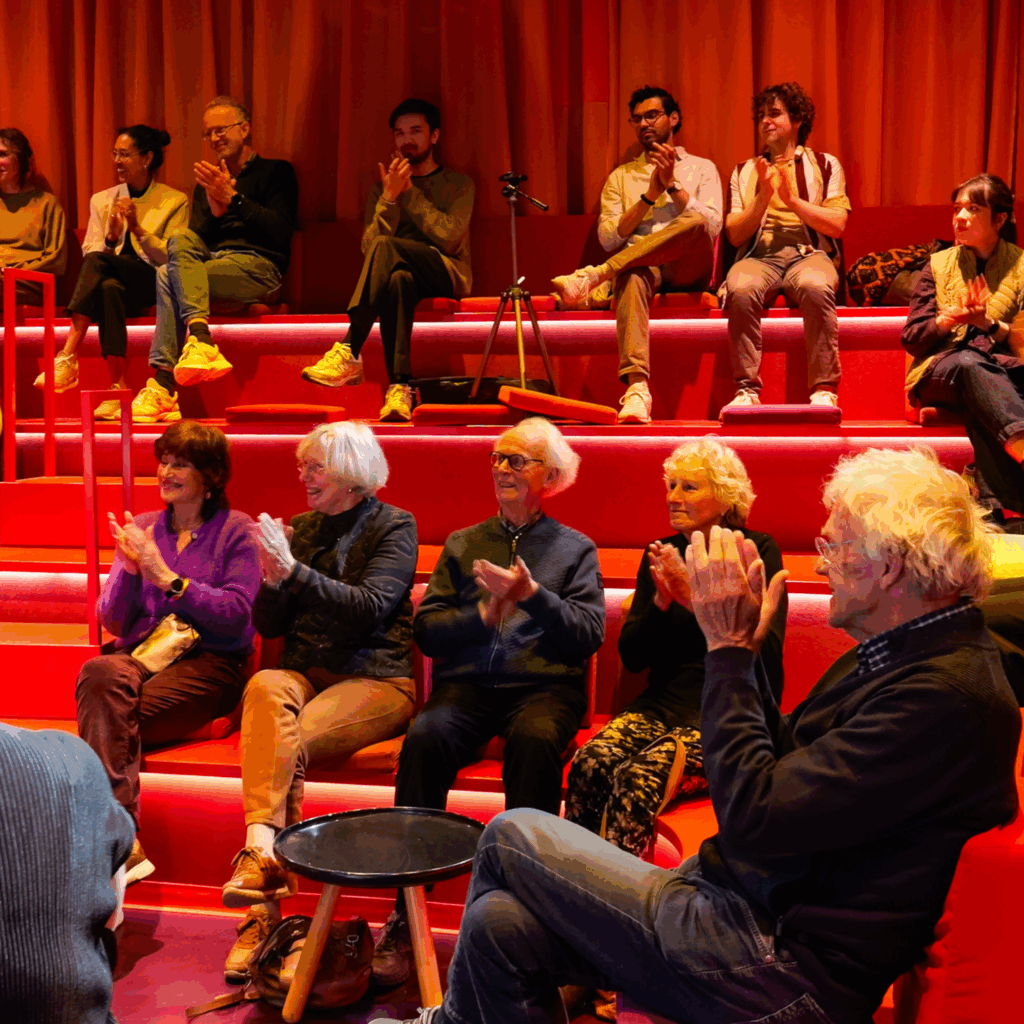
the red space. Deep red, pink, orange, purple. A professional theatre with a round U-shaped tribune that seats up to 80. Accessible from the grand space or the garden. This is where shows happen, screenings happen, immersive formats happen. Fifty to sixty people feel right here. Twenty or fewer and the space starts to swallow the group.
the white space. Upstairs. Large white windows looking out to Amsterdam rooftops and the garden. Seats 70 in theatre setting, 50 with tables. This room has held trainings, book launches, PhD promotions and weddings. It is flexible in a way that does not feel like a compromise.
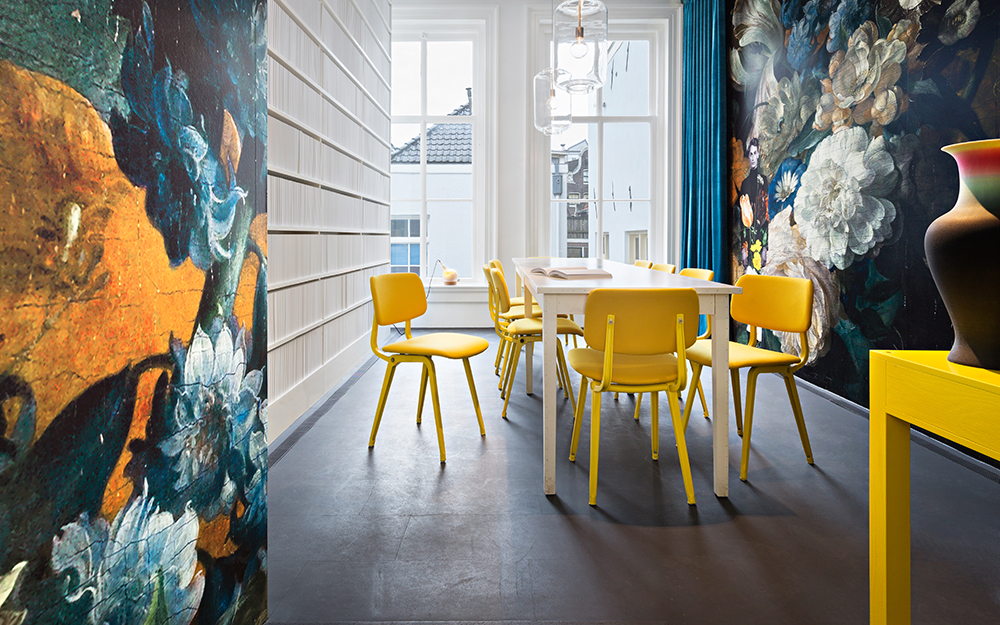
the library. Also upstairs. Yellow chairs around a long table, a flat chandelier above, flowered wallpaper drawn from a Rijksmuseum painting. Ten people maximum at the table. This is where the twelve-person meetings happen that would have died in a hotel conference room. It also works as a private dining room.
the cafe. At the top of the yellow staircase. Open daily for lunch and coffee, with views over the Groenburgwal canal. A blue butterfly lamp, a curved white tiled bar, a fireplace, an inside-out cafe concept. Stands 180, seats 70. This may be the most beautiful room in the building. It is available for your event too.
Events are not limited to one room. Add rooms as you need them. Breakouts in the library, plenary in the grand space, drinks in the cafe, a show in the red space. The building is designed to hold a full day.
what kind of events work well here?
The short list: conferences, panel discussions, workshops, trainings, leadership offsites, product launches, press events, symposiums, recording sessions, live-streams, PhD promotions, book launches, private dinners, networking events, celebrations.
The longer answer: any event where the environment is part of the message. If you are gathering people to think differently, to launch something that challenges the status quo, or to bring together a community that values craft and intention, @droog is built for that.
If you need a neutral backdrop, this is probably not the right space. But then Amsterdam’s city centre is probably not the right city either.
sustainability and local sourcing
These are not add-ons at @droog. They are structural. The building itself reflects a commitment to sustainable design. Nearly everything inside has been chosen or built with environmental responsibility in mind. Catering prioritises local sourcing, and the kitchen reflects that in what it puts on the table.
If sustainability is part of your event’s narrative, or part of your organisation’s values, the venue reinforces that without you having to explain it. The building makes the argument for you.
For organisations with ESG commitments or CSR reporting requirements, choosing a venue that is genuinely aligned with those values, rather than certified on paper, is increasingly important. Attendees notice the difference.
frequently asked questions
Is Amsterdam easy to reach from other European cities?
Yes. Schiphol connects to over 300 destinations worldwide. Travel time from London is roughly an hour by plane or four hours by Eurostar. From Brussels, Paris, Frankfurt and Cologne, train travel is practical and increasingly preferred. The city centre is about 20 minutes from the airport by direct train.
How far in advance should I book a venue in Amsterdam?
For peak periods (spring and autumn, especially around Dutch Design Week in October), 6 to 12 months is realistic. For less busy periods, 3 to 6 months usually gives you good options. At @droog specifically, availability varies by room and combination, so the earlier you reach out the better.
What is the maximum capacity at @droog?
This depends on which rooms you use and how. The grand space alone holds up to 160 standing or 90 seated. The cafe holds up to 180 standing. Combined, the full building can accommodate a meaningful full-day programme for groups ranging from 10 to several hundred, depending on format.
Is @droog only for design industry events?
No. The design background creates the context and the culture of the space, but the building hosts events across sectors: finance, tech, pharma, fashion, education, government and more. What they tend to share is an interest in doing things with intention rather than by default.
Can I combine multiple rooms for a full-day programme?
Yes, and this is one of the strengths of @droog. You can run a plenary in the grand space, breakouts in the library or white space, lunch in the cafe and a closing session in the red space. The building is compact enough that moving between rooms takes seconds, not minutes.
Does @droog handle catering?
The cafe restaurant is on-site and available for your event. Catering is built around local sourcing and can be tailored to your programme, whether that is a working lunch, a formal dinner or drinks at the end of the day.
Is Amsterdam expensive compared to other event cities?
Amsterdam sits in the middle range of European event cities. It is more expensive than some Eastern European capitals but generally more affordable than London or Zurich. The value case is strongest when the city and venue align with your event’s purpose, because you are not paying just for square metres but for a context that works.
What makes @droog different from other Amsterdam venues?
The building has been a home for design culture since 1993. Everything inside reflects a design philosophy, not a decoration scheme. You are not renting a room with a view. You are borrowing an argument about how things should be made, and placing your event inside it.
before you decide
Here are the questions worth answering before you commit to a city or a venue:
- What do you want your attendees to feel when they walk in? Before the programme starts.
- What does the space say about what you value?
- Is the environment going to work for you or against you?
- Are you choosing a city because it is convenient, or because it is right?
Amsterdam is not the answer to every question. But for events that want to create something lasting, where the thinking matters as much as the agenda, it is one of the better cities in Europe to do it in. And @droog is one of the better buildings in Amsterdam to do it from.
The building is from 1641. The design thinking is from 1993. The room can be yours next month. Tell us what you have in mind.