

what should you pay attention to when organising an event?
what should you pay attention to when organising an event?
Organising an event sounds simple until you are in the middle of it. The room is wrong, the timeline is off, and someone forgot to confirm the catering. Most event problems are not dramatic. They are predictable, and they are preventable if you know what to look for early on.
This guide walks you through everything that actually matters when planning a professional event, from the first decision you make to the last detail before the doors open. Whether you are organising a conference, a workshop, a product launch, a dinner, or a hybrid of all four, the same principles apply.
start with the why, not the what
Before you book anything, write one sentence that describes what the event is for. Not the programme, not the theme. The purpose. What should attendees think, feel, or do differently after they leave?
This sounds obvious. It is also the step most event organisers skip. When the purpose is clear, every other decision becomes easier: the right size of room, the right format, the right food, the right amount of time. When the purpose is vague, you end up making decisions by gut feeling and adjusting too late.
At @droog, every event starts with this question. The building was designed around a single idea: design thinking changes how people approach problems. That philosophy shapes everything from the choice of furniture to the layout of the rooms. Your event does not need a philosophy, but it does need a reason to exist.
choose the right space before you build the programme
Most organisers do this the wrong way around. They plan the programme first, then look for a space that fits. It works, but it limits you. The space shapes the experience before a single speaker opens their mouth.
Here is what to consider when evaluating a venue or a room:
- Capacity that fits the group. A room that holds 80 feels empty with 20 people in it. A room built for 30 feels claustrophobic with 50. Both affect energy, focus and how willing people are to participate.
- Natural light and acoustics. Both are underestimated. Bad acoustics make a panel discussion exhausting. No natural light makes a full-day workshop feel like a basement.
- Flexibility of layout. Can you rearrange the room? Can you split it? Does it support theatre-style seating as well as round-table conversation? Fixed seating limits your programme.
- Technical infrastructure. Beamer, screen, microphone, sound system, livestream capability. Check what is included and what you need to bring in.
- Access and adjacency. Where is the catering? Where do people go between sessions? Is there a breakout room, a garden, a place to stand and talk without blocking a doorway?
At @droog in Amsterdam, the rooms are built around this kind of thinking. the grand space on the ground floor, for example, sits up to 90 people in a seated format or 160 standing, with a stage and a giant sliding door that opens directly onto the garden. That combination means you can run a plenary session in the morning and a networking reception in the afternoon without moving anyone to a different building.
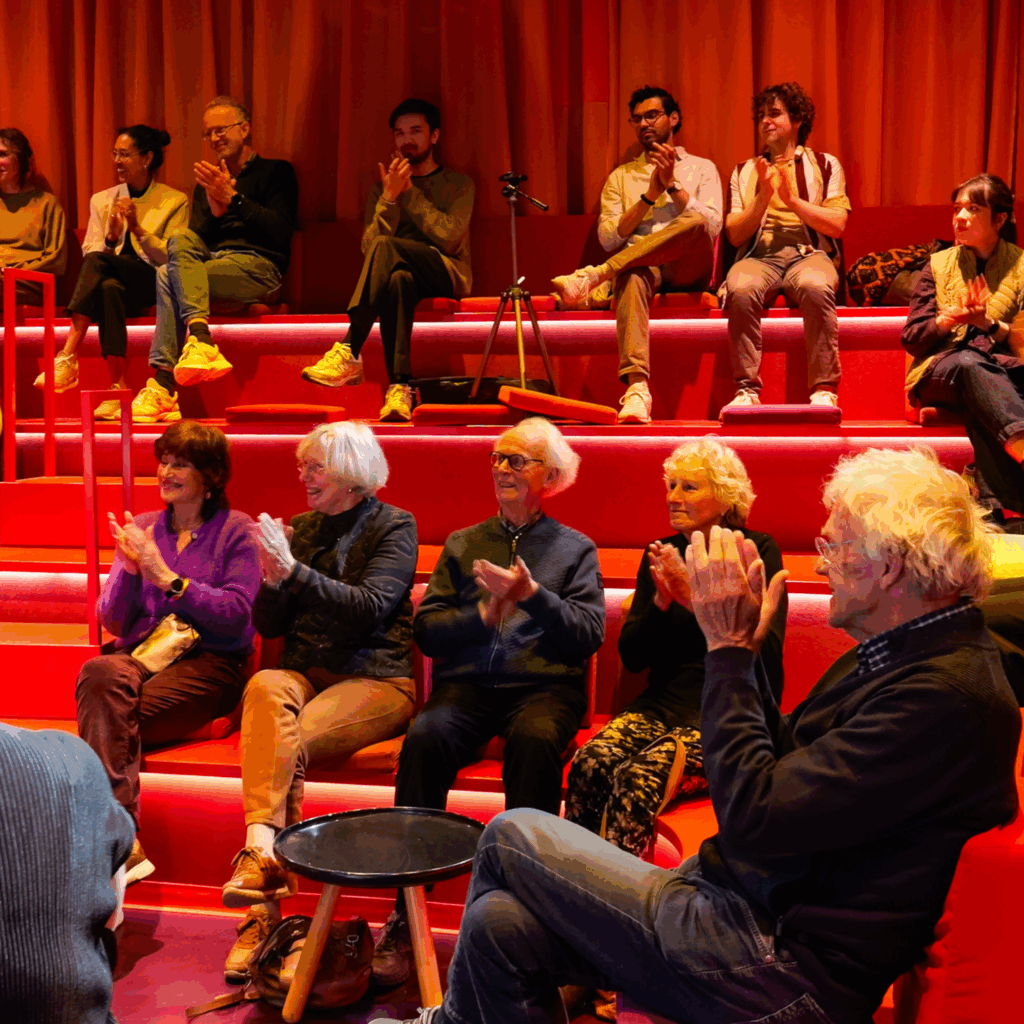
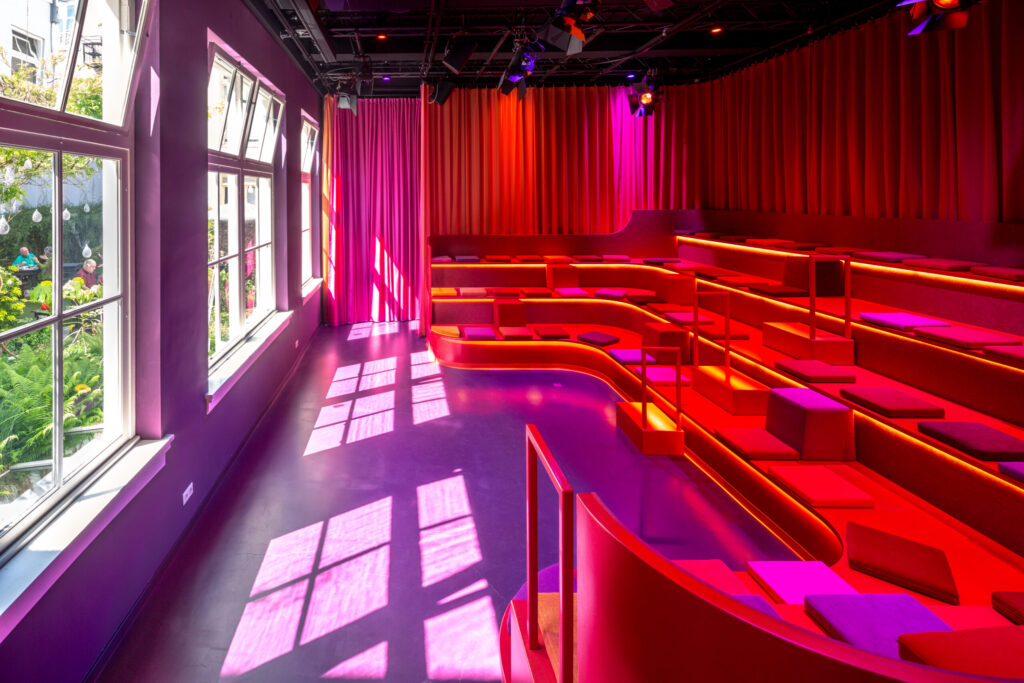
the red space is a professional theatre room, entirely in red, pink, orange and purple, with a u-shaped tribune for up to 80 people and full theatre equipment. It works for shows, talks, screenings and panel discussions where you want the audience focused on a single point. It is not the right room for a brainstorm. Knowing the difference matters.
the white space sits upstairs, with large white windows looking out over the old Amsterdam canal houses. It fits 70 in theatre setting or 50 with tables. Good for trainings, workshops, or any format where participants need to work, not just listen.
the library is a ten-person meeting room. Yellow chairs around a long table, flowered wallpaper based on a Rijksmuseum painting, windows facing the garden. It holds exactly ten people at the table, no more. It is also a good room for a private dinner.
the cafe sits at the top of the yellow hallway staircase and looks out over the Groenburgwal canal. Up to 180 standing, 70 seated. Blue butterfly lamp, a fireplace, a curved white-tiled bar. It has been a lunch space and an event space in the same week. Most weeks, in fact.
design the flow, not just the schedule
A schedule tells people when things happen. Flow tells people how the day feels. They are not the same thing.
Flow is what happens between the sessions. It is the transition from a formal plenary to an informal lunch. It is whether people have space to process what they heard before the next speaker begins. It is whether they feel rushed or whether they have time to talk to each other.
A few practical principles for designing good flow:
- Build in more transition time than you think you need. Twenty minutes between sessions disappears fast when you factor in people moving, finding seats, asking questions and refilling coffee.
- Change the room setting when you change the purpose. A morning plenary in theatre style and an afternoon workshop with tables sends a signal that something different is happening now. People adjust their behaviour accordingly.
- Plan where the conversations happen. The best outcomes from an event often come from unplanned conversations. Give those conversations a physical home: a garden, a bar, a hallway with chairs. Do not leave it to chance.
- End deliberately. The close of an event is as important as the opening. Give people something to take with them: a question, a commitment, a next step. An event that ends with logistics and travel updates leaves a different impression than one that ends with intention.
catering is not an afterthought
Food and drink affect concentration, energy and mood. They also communicate something about how much thought went into the event. Sandwiches on a plastic tray say something. So does a chef-prepared lunch at a table with a view of a canal.
The practical questions to answer early:
- When do people eat and drink, and where? Does catering happen in the same room or in a separate space?
- What are the dietary requirements of your group? Collecting this late creates stress and substitutions that feel like an afterthought.
- Is the catering partner aligned with your values? If sustainability is part of your event message, a caterer that sources locally and seasonally reinforces that. A caterer that does not, contradicts it.
- How does catering affect the timing? A sit-down lunch takes longer than a standing lunch. Build the right amount of time into the schedule.
@droog works with a kitchen that prioritises local sourcing. That is not a detail added for marketing purposes. It reflects the same logic that runs through every decision in the building: what you choose communicates what you believe.
technical setup: the invisible infrastructure
No one notices good technical setup. Everyone notices bad technical setup.
Run through this before the event:
- Sound. Can people in the back of the room hear clearly? Is there feedback from the microphone? Do the microphones work with the A/V system?
- Projection. Is the screen visible from all seats? Is the resolution high enough for the content being shown? Who controls the clicker and what happens if it dies?
- Connectivity. Does the venue have reliable WiFi? What is the password and how is it communicated? If you are running a hybrid event, what is the upload speed?
- Hybrid and streaming. If some participants join remotely, who manages that stream? Is there a dedicated operator or is the moderator expected to manage both the room and the online participants at the same time?
- Backup. What happens if the beamer fails? What happens if the internet drops? Having a plan for these is not pessimism. It is professionalism.
Do a full technical run-through the day before or the morning of the event, with the actual content that will be shown. Not a summary. The actual files, the actual connections, the actual camera angles.
communication before the event
How you communicate with attendees before the event shapes their expectations and their experience on the day. A few things that are often handled too late:
- Practical information. Address, arrival time, parking or public transport options, what to bring. Send this early and repeat it closer to the date. People lose emails.
- What to expect. If the format is unusual, say so. If attendees will be asked to participate actively, let them know in advance. Surprises work in some contexts and not in others.
- Preparation. If participants will be more effective if they have read something, watched something, or thought about something beforehand, ask them to do that early enough that they actually will.
- Confirmation and reminders. Send a confirmation immediately after registration. Send a reminder a week before, and one the day before. Three touchpoints is not too many.
on the day: what to watch for
The planning is done. The event is running. Now your job shifts from organiser to host.
A few things that experienced event organisers watch for during the day itself:
- Energy in the room. Are people engaged? If the energy is dropping, something needs to change: a break, a different activity, a change of pace. Trust what you observe.
- Time. Sessions almost always run long. Decide in advance whether you will cut content or cut the break. Cutting the break is usually the wrong choice.
- The small things that feel large. A room that is too warm. A microphone that cuts out. Coffee that ran out an hour ago. These feel minor from the outside and significant from the inside. Have someone watching for them.
- The unexpected conversation. Sometimes the most important thing that happens at an event is a conversation in the hallway. Create the conditions for that and then get out of the way.
after the event: close the loop
An event that ends without follow-up loses half its value. The work done in the room needs somewhere to go after the room empties.
- Send a summary or recap. What was decided? What were the key insights? What are the next steps? Get this out within 48 hours while it is still fresh.
- Ask for feedback. A short survey, three to five questions, sent the day after. What worked, what did not, what would they change. This is the information that makes the next event better.
- Follow up on commitments. If something was promised in the room, track it. If people signed up for something, follow through. The event is not over when the venue is empty.
- Document what you learned. Write down what worked and what you would do differently. Institutional memory about event planning disappears fast. Capture it.
frequently asked questions
how far in advance should you start planning an event?
For a half-day event with under 50 people, six to eight weeks is workable. For a full-day event, a conference, or anything with complex logistics, three to six months is realistic. Venues fill up, speakers have long lead times, and good catering partners book out. The earlier you start, the more options you have.
what is the most common mistake event organisers make?
Underestimating transition time and overestimating how much content fits in a day. A six-hour programme with eight sessions leaves no room for conversation, which is often the most valuable thing that happens at an event. Build in white space. Deliberately.
how do you decide how many rooms you need?
Count the number of simultaneous activities you want to run. A plenary with breakout sessions needs at least one main room and two or three smaller ones. A conference with parallel tracks needs enough separate spaces that sound does not travel between them. At @droog, events regularly combine multiple spaces: the grand space for a keynote, the red space for a panel, the library for a working lunch, the cafe for an evening reception. You do not have to choose one room.
what should you always confirm with a venue?
Capacity by setup (theatre, classroom, boardroom, standing), technical equipment and what it costs to supplement it, catering options and whether external catering is permitted, access times for setup and breakdown, noise restrictions, and who your day-of contact is. Get these in writing.
how do you make a hybrid event work?
Treat online participants as first-class attendees, not as observers. This means dedicated facilitation for the online group, a moderator who watches the chat and feeds questions into the room, and technical setup that makes the remote experience clear and interactive. Hybrid events fail when the online component is an afterthought. They work when it is planned for from the start.
how do you handle dietary requirements without making it complicated?
Collect requirements at registration, not afterward. Group them into categories: vegetarian, vegan, gluten-free, nut allergy, other. Share this with your catering partner at least two weeks before the event. Confirm again three days out. Label everything clearly on the day.
what makes a venue right for a B2B event specifically?
For B2B events, the environment communicates something about the organising company. A generic hotel conference room is neutral in a way that says nothing. A space with character, history, and intentional design says that the organiser thought about the experience. For events where the goal is to shift thinking, challenge assumptions, or bring people together around a shared purpose, the space is not a backdrop. It is part of the argument.
a practical checklist
Use this to verify you have covered the essentials:
- Purpose of the event written in one sentence
- Venue confirmed with all rooms needed for the format
- Capacity checked against expected attendance by room
- Technical requirements listed and confirmed with venue
- Catering confirmed, dietary requirements collected
- Programme scheduled with realistic transition times
- Practical information sent to attendees
- Day-of contact confirmed at the venue
- Backup plans for key failure points
- Follow-up plan ready to send within 48 hours after the event
Organising a good event is not complicated. It is thorough. The difference between an event that works and one that does not is usually not creativity or budget. It is whether someone paid attention to the details early enough to fix them before the day arrived.
If you are planning an event in Amsterdam and want to talk through what format and space might work for your group, tell us what you have in mind.