

how do i organise an inspiring b2b event?
how do you organise an inspiring B2B event?
Most B2B events feel the same. A hotel ballroom. A projector that takes ten minutes to connect. Coffee from a urn nobody refilled. People sit, people listen, people leave. Two days later, nothing has changed.
Inspiring is harder to fake than professional. You can rent the right AV equipment, print the right lanyards, hire the right caterer. None of that is the problem. The problem is that most events are designed around logistics, not around the question that actually matters: what do we want people to think differently about when they walk out the door?
This guide answers that question, step by step. It draws on real experience, real spaces, and real decisions that determine whether an event lands or disappears into the inbox.
start with a why, not a venue
Before you book a room, write one sentence. Not a theme, not a title, not a tagline. A sentence that describes the shift you want to create.
Something like: we want our team to stop thinking about quarterly targets and start thinking about the next decade. Or: we want our clients to experience how we think, not just what we sell.
That sentence does three things. It tells you what kind of space you need. It tells you what kind of speakers or facilitators belong in the room. And it gives you a filter for every decision that comes after it. When a supplier pitches something, you ask: does this serve the shift we want to create? If not, cut it.
Events without a why become events about the event itself. Programmes that exist to fill time. Panels that exist to look impressive. Dinners that exist because dinners are what you do. None of that is inspiring. It is expensive and forgettable.
the space is not neutral
Rooms carry meaning. A hotel conference room says: this is a meeting. A heritage building with a design history says something else entirely. The space you choose primes every conversation that happens inside it.
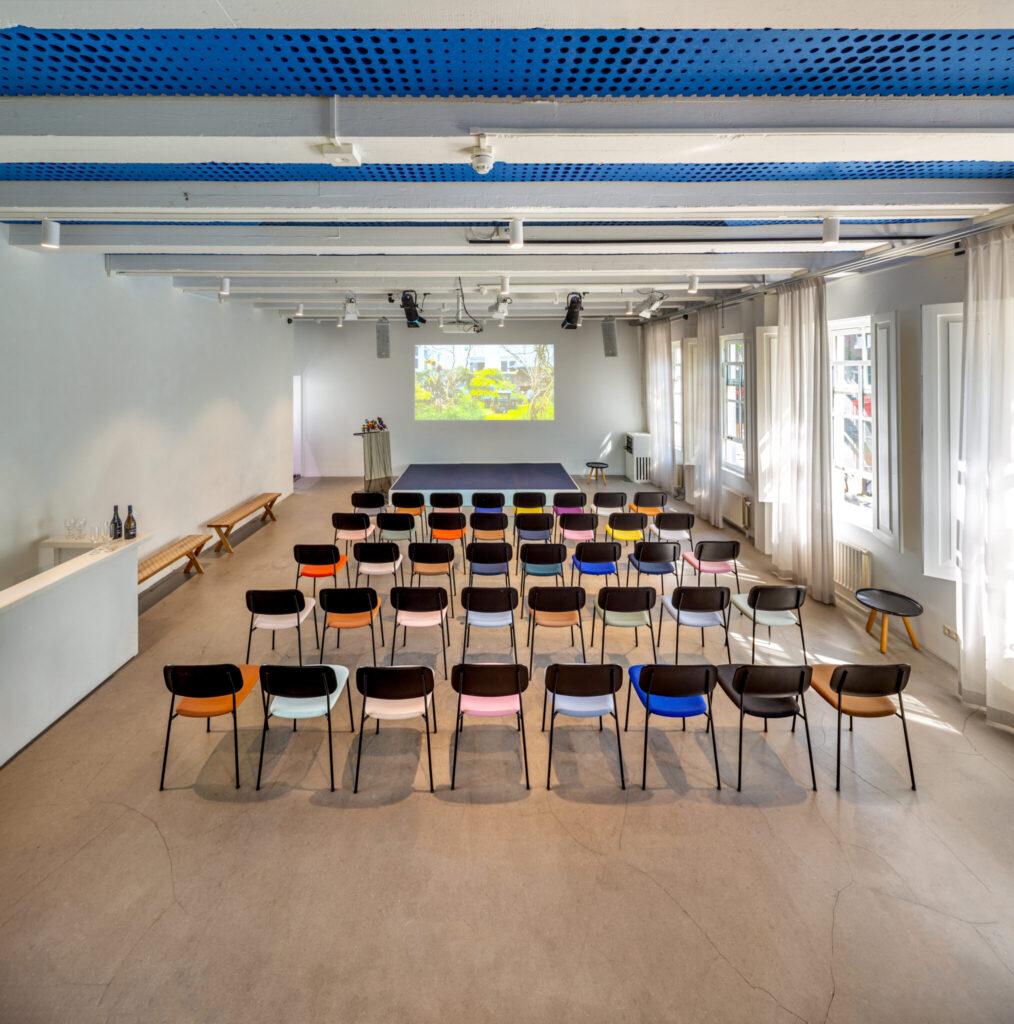
At the grand space in our building on the Groenburgwal canal, we have run everything from brand pop-ups to plenary conferences to networking drinks. 90 people seated, 160 standing, stage included. The space has a sliding door that opens directly onto the garden and adjoins the red space. What it does not have is the feeling that every decision was made to be inoffensive. That distinction matters more than square metres.
The right venue for an inspiring B2B event is one where the environment itself is already doing part of the work. Where people walk in and feel that something is different here. Not because you hung a banner, but because the room has a point of view.
format follows function, not convention
The default B2B event format is: keynote, panel, lunch, breakout, wrap-up. There is nothing wrong with this. There is also nothing inspiring about it. Convention is comfortable. Inspiration usually requires a format that does not feel entirely familiar.
A few questions worth asking before you set a programme:
- When do you want people talking to each other, not listening?
- What is the moment of surprise or discomfort that shifts the room?
- Is there a physical experience, not just a verbal one, in the day?
- How does the room change shape during the event?
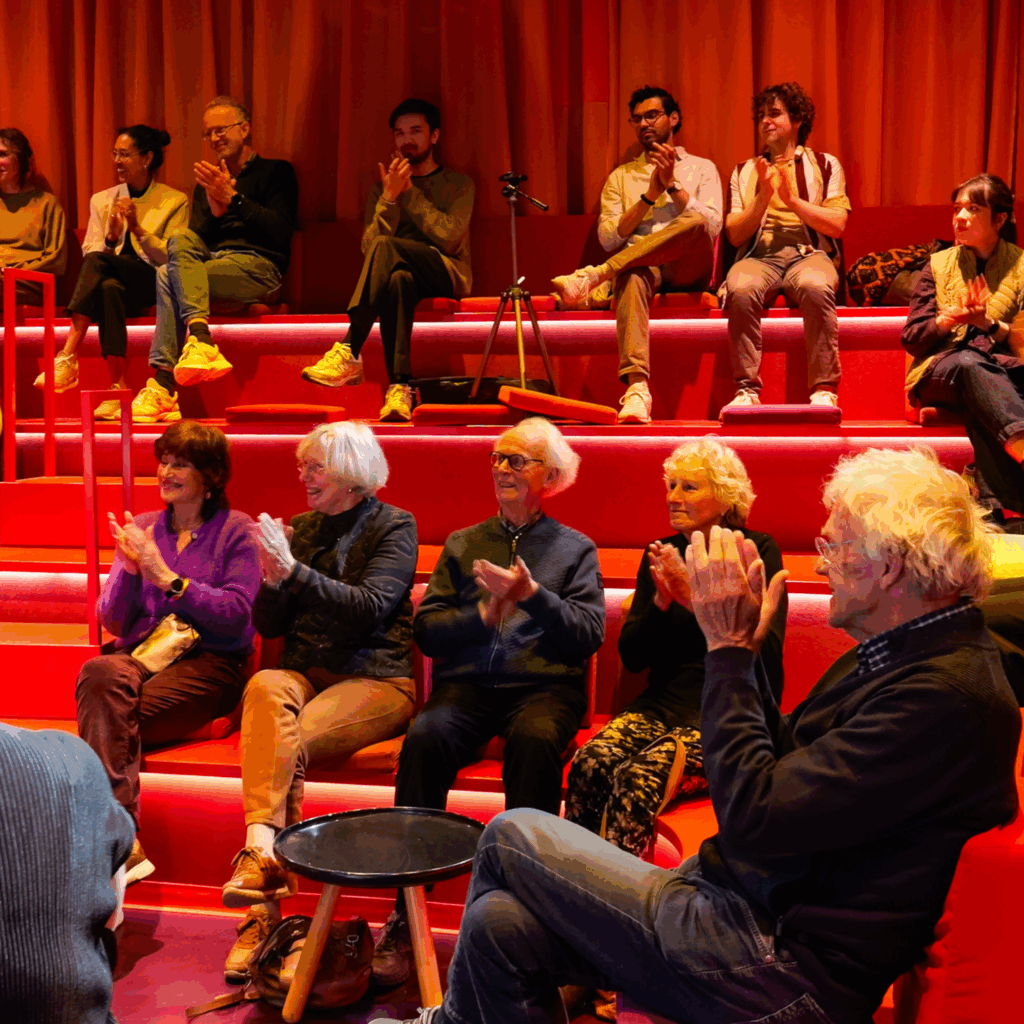
That last question is more practical than it sounds. The red space, for instance, is a full theatre room: red, round, u-shaped tribune, movable cushions, seats up to 80 people. It runs on the same level as the garden and the grand space. A symposium that starts in one room and moves to another, or that sends people outside between sessions, creates a sense of progression that a single static room cannot.
Movement is underrated as a design tool in event programming. When people stand up and move, something resets. Use it deliberately.
what actually makes content inspiring
Three things make content land differently from a stage or a table:
Specificity. A speaker who says “innovation requires courage” is not inspiring. A speaker who says “in 2019 we destroyed a product line that was generating twelve million euros a year, and here is exactly why” is. Concrete details, real decisions, honest consequences. That is what people remember and repeat.
Disagreement. A panel where everyone agrees is not a panel, it is a press release. Build in a genuine point of tension. Two people who see the same problem differently, facilitated well, is worth more than six people who confirm each other for ninety minutes.
Participation. Inspiring events ask something of the people in the room. Not just their presence, not just their attention, but their thinking. Facilitated workshops, structured conversations, physical tasks, design challenges. When people contribute, they own the output. When they sit and listen, they remember thirty percent of it by Friday.
At @droog, the design thinking tradition behind our building shapes how we approach this. Every event can be a canvas, not just a container. The question is whether you choose to use it that way.
design your spaces for the whole day
An event is not just the main programme. It is the moment before it starts, the lunch break, the conversation that happens in the hallway between sessions. Good event design takes all of it seriously.
A few practical points:
Entry and arrival matter. The first five minutes shape the expectation for everything that follows. What do people see when they walk in? What does the room tell them about what kind of day this is going to be?
Breaks are not interruptions, they are part of the programme. If you want people to connect, create conditions for connection: a lunch setup that forces different conversations, a coffee break in a different room, an outdoor moment if the weather allows.
End deliberately. The last moment of an event is the one people carry home. A strong closing provocation, a ritual, a shared commitment, something physical to take with them. Not “thank you for coming, safe travels”. That is a refund, not a close.
Our spaces support this kind of day-design. The white space upstairs fits 70 in theatre setting or 50 with tables, with large windows looking out over the Amsterdam canal houses and the garden below. It runs breakout sessions, trainings, PhD promotions, book launches. The library next to it seats ten around a long table under a flat chandelier, wallpaper based on a Rijksmuseum painting, yellow chairs. It is the right room for a private lunch between senior stakeholders, or a focused working session that needs to feel different from a board meeting.
Events are not limited to one space. When you need more room, you add more rooms. Break-outs, dinners, training tracks, recordings, celebrations: all of it becomes possible when the building has more to offer than one hall and a lobby.
If you want to talk through what a multi-space day at @droog could look like for your event, this is where you start:
food and atmosphere are part of the content
Nobody remembers the AV rig. They remember the lunch.
Food and atmosphere are not separate from the event experience. They are part of it. A lunch that is worth sitting down for, in a room that is worth being in, extends the conversation by forty-five minutes without a single agenda item.
The cafe restaurant at @droog has been serving that idea since it opened: that lunch is worth sitting down for. It sits at the top of the yellow hallway staircase, with a view over the Groenburgwal canal. The blue butterfly lamp, the curved white-tiled bar, the fireplace. It fits 70 seated or 180 standing. Rooted in local sourcing, designed to feel like more than a catering break.
Sustainability is not a feature we added. It is part of the building’s identity and the thinking behind every choice we make in it, including the kitchen.
the role of design in B2B events
Design thinking is not a workshop format. It is a way of asking questions.
The Droog Design philosophy, which has shaped this building since 1993, starts from the conviction that everyday objects and conventions deserve to be questioned. The most familiar things, a chair, a drawer, a meeting room, are often the most interesting to rethink.
Applied to B2B events, this means: do not accept the default. Ask why the chairs face the front. Ask why the day starts with the most senior person in the room. Ask why lunch happens at a table instead of a walk. Some of those answers will be fine. But asking the question opens up decisions you did not know you were making.
The venues that facilitate this kind of thinking are not the ones with the most sophisticated AV. They are the ones where the room itself invites a different kind of attention.
practical logistics: what you cannot skip
Purpose and design thinking matter. So does the checklist. Here is what goes wrong in inspiring events that are not planned carefully enough:
- Speakers who have not been briefed on the event’s why, so they deliver their standard talk
- A programme that runs fifteen minutes long in every session and arrives at dinner forty minutes late
- A room set up for 80 people when 35 attend, which makes every quiet moment feel like failure
- Technology that takes attention away from the room instead of serving it
- No one person with authority to make real-time decisions when something changes
A note on room size: the red space looks empty with fewer than 20 people in it. The grand space is best from 40 upward. The library stops working for meetings above ten. Match your headcount to your room honestly, not optimistically.
how to measure whether an event was inspiring
Surveys are useful but limited. They capture satisfaction, not impact.
The real questions to ask, two weeks after the event:
- Did anything change in how people talk about the problem the event was designed around?
- Did anyone bring a specific idea, conversation or challenge from the event back into their work?
- Are people who were in the room still in conversation with each other?
- Was there a moment someone mentioned unprompted?
If the answer to three of those four is yes, the event did what inspiring events are supposed to do. If the answer is none, you may have produced a very well-organised day that changed nothing.
That is the honest standard. Not Net Promoter Score. Not catering feedback. Not how well the projector worked.
frequently asked questions about organising inspiring B2B events
how far in advance should I book a venue for a B2B event?
For events of 50 people or more, six to twelve months is the realistic window for venues with a specific character. Generic hotel spaces are often available on shorter notice, but if the venue matters to the experience, you plan early. For smaller events of 10 to 30 people, three to four months is usually enough, depending on the time of year.
how many speakers is too many for a one-day event?
Four to six is a comfortable range for a full day. More than that, and the event becomes a series of presentations rather than a coherent experience. If you have ten people who need a moment in the programme, consider a structured conversation format instead of ten separate slots.
what is the right room size for my event?
Err smaller, not larger. A room that is eighty percent full feels alive. A room that is fifty percent full feels like something went wrong, regardless of how good the content is. If you are uncertain about attendance, choose the smaller room and open an adjacent space if demand exceeds it.
should I combine multiple rooms for one event?
Yes, if the programme justifies it. A plenary session in one space, breakouts in smaller rooms, lunch in a third space: this creates a sense of movement and progression that a single room cannot replicate. It also gives people physical memory anchors for different parts of the day, which improves retention.
how do I make a hybrid event inspiring, not just functional?
Design for the remote audience as a primary audience, not as an afterthought. That means a dedicated camera operator, a facilitator who explicitly includes remote participants, and content that is produced for screen as much as for the room. Hybrid events that are filmed versions of in-person events rarely inspire either audience. They need their own format logic.
what makes a venue good for B2B events specifically?
Three things: a room that fits your format without compromise, technical infrastructure that works without needing a technician in the room for every adjustment, and a team that has done this before and can anticipate problems. Beyond that: does the venue have a point of view? Does the environment itself contribute to the conversation you want to have?
how do I keep energy high throughout a full-day event?
Vary the format every sixty to ninety minutes. Standing, sitting, small groups, large groups, listening, doing. Build in two breaks that are long enough to actually have a conversation, not just collect a coffee. Put the most demanding content in the morning, not after lunch. End with something that creates energy rather than something that summarises what just happened.
one last thing
Inspiring B2B events are not the result of a bigger budget or a more famous speaker. They are the result of a clearer question asked earlier in the process. What do we want to be different when people leave? Everything else, venue, format, food, technology, follows from that.
@droog has been a place where that question gets answered in interesting ways since 1993. The building on the Groenburgwal is available for your event. The thinking that shaped it comes with it.